This is part of our Guide to Comparing AI in Qualitative Software | Take Our Free Online Qualitative Data Analysis Course | Start a Free Trial of Delve
You’ve probably thought about it. Upload your transcripts to ChatGPT, ask for themes, and get results in a few seconds. A handful of researchers have already tried this exact approach to do thematic analysis in hopes of understanding where and when these AI tools can help with thematic analysis.
This article looks at the limitations with the “dump and done” approach, then highlights a few ways ChatGPT (and AI-assistant style tools like Delve) still save you time for thematic analysis.
What ChatGPT gets wrong about thematic analysis
ChatGPT misses two main things. The human element that makes thematic analysis so valuable, and the context it needs across conversations. Over the past two years, researchers tested ChatGPT using Braun and Clarke’s six-step framework. Morgan, Nguyen-Trung, Cook, Naeem, Wachinger, and others found AI struggles with the interpretive, human-centered work that separates rigorous analysis from topic summarization.

As Nguyen-Trung warns, trusting ChatGPT to generate codes, clusters, or themes “risks oversimplifying nuanced data, and more importantly, losing our identity as qualitative researchers.” So what exactly goes wrong? They reported a handful of recurring issues:
1. You get topics, not themes
ChatGPT produces what researcher David Morgan calls “topic summaries” — descriptive, surface-level labels for what people talked about. A good starting point, but not the same as interpretive themes that capture meaning. When you skip straight to asking AI for themes, you outsource this meaning-making.
An AI-generated theme might say that participants Discussed work–life balance. A true theme captures an underlying pattern, such as Negotiating guilt through redefined expectations, showing how participants managed competing roles by adjusting their standards of success. One describes what participants said. The other interprets what it means. It adds something new.
By default, ChatGPT leans toward these descriptive outputs. Topic-based labels. Clean summaries. It can tell you that several participants mentioned feeling “overwhelmed,” but not exactly why. Maybe one person feels overwhelmed by unpredictability, another by responsibility, another by lack of support. Those distinctions are where themes are built, and AI tends to flatten them into a single label.
2. AI sounds right even when it’s wrong
ChatGPT doesn’t just produce topic summary outputs. It produces them confidently, which makes it easy to miss when those outputs aren’t grounded in your data.

AI outputs are fluent, confident, and persuasive. Even when they’re entirely made up. David Cook and his colleagues call this “truth-y nonsense — highly readable but wrong.” Wachinger adds that ChatGPT would “convincingly argue connections” to any theoretical framework, “even for unfitting models.”
AI might tell you participants expressed concern about something they never mentioned. Or confidently connect ideas your participants kept separate. The output looks convincing with theme names, supporting quotes, everything formatted nicely. But can you defend those results to your dissertation committee?
Without knowing your data, you can’t catch what Morgan calls “nonsense responses.” Your knowledge of what’s actually there is the only way to know when AI invents results. This is why Cook also emphasizes: “Not only must there be a ‘human in the loop’, the human must be in charge of the loop.”
3. Breadth without depth
ChatGPT’s confident topic summaries (Problem 1) and convincing fabrications (Problem 2) stem from how AI processes data. It covers ground fast by identifying language patterns, not meaning.
That means AI can process huge volumes of data and identify surface-level patterns. But humans, as Naeem and colleagues argue, bring the theoretical depth. AI tends to latch onto one or two prominent topics while missing key nuances. Morgan adds that “ChatGPT showed a clear tendency to emphasize more specific aspects of the data, without pointing to the bigger picture that united these specifics.”
This plays out in what AI actually responds with. It spots high-frequency patterns but misses edge cases. Cook puts it bluntly: AI “focuses on majority opinions rather than exploring insights suggested by exceptions.” But thematic analysis isn’t about finding the most frequent thing. The exceptions and edge cases often reveal subtle nuances. The contradictions expose tensions worth exploring.
What stands out across all three problems? Faster isn’t always better, tempting as it might be. As we explore in our guide to AI in qualitative analysis, getting outputs that look like finished analysis in minutes can short-circuit the immersion thematic analysis depends on.
So, is there any point in using AI for thematic analysis? Yes, just not the “dump and done” way.
Final results: ChatGPT can help, just not by itself
ChatGPT can still help with thematic analysis, just not on its own. It’s useful when you already understand the method and can clearly define what role you want it to play.
At its best, it offers a fresh set of eyes on your data. A second opinion about something you just read. Suggesting codes for you to accept, revise, or discard. Pulling together excerpts when you already know what you’re looking for. It gives you a secondary lens to look things over and spot patterns.
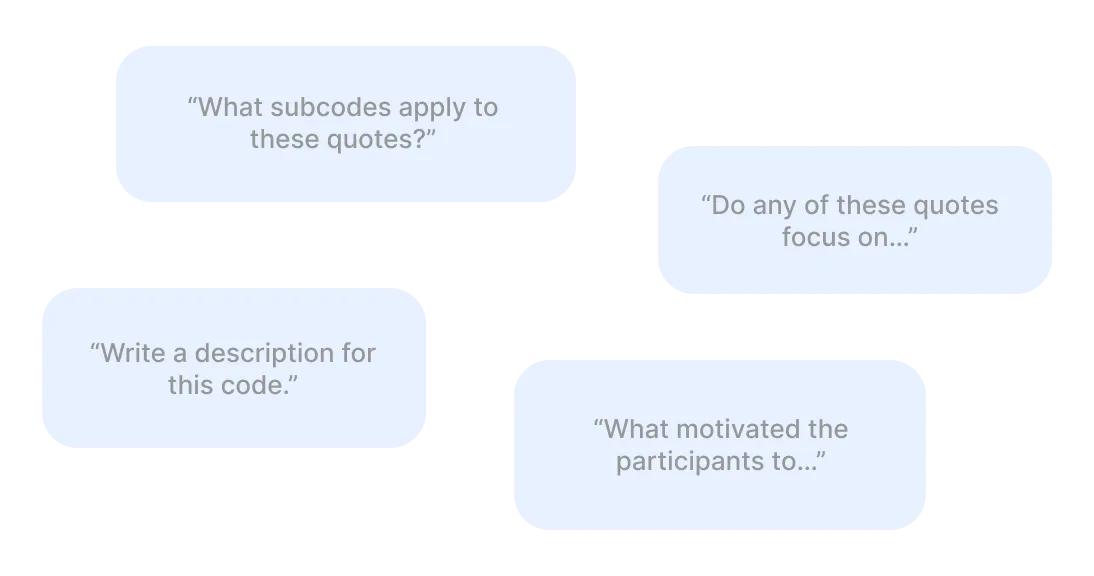
The value comes from focused, iterative questioning. ChatGPT works better when you give it specific excerpts and ask targeted questions, just like coding qualitative data works better when you cluster related quotes to explore patterns. Give it targeted excerpts and ask specific questions, and it can help you see connections you might have missed. Feed it everything at once, and you get surface-level summaries.
ChatGPT simply isn’t designed to retain your codebook, track decisions, or preserve context as themes evolve. Each prompt starts fresh, which works for isolated tasks but not as an ongoing, iterative workflow.
AI built for thematic analysis
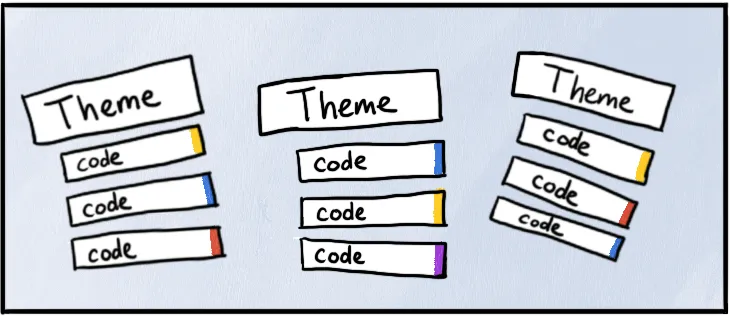
Thematic analysis builds reliability through this cyclical accumulation of evidence. You gather quotes into codes. Use memos to track those codes over time. Those codes cluster into themes. Each theme rests on verified excerpts you can trace back to their source. That’s how qualitative research maintains rigor.

Popular chatbots like ChatGPT, Google’s Gemini, and Claude by Anthropic struggle to keep context within this iterative workflow. Over several cycles, you revisit transcripts, and revise codes. You test interpretations against earlier decisions. That work depends on continuity. When context disappears between the AI’s prompts, so does your analytic thread. You break the context chain.
What matters most? You stay in control. Delve’s AI assistant can suggest codes, help you explore patterns, even apply an existing deductive codebook. But nothing happens without your approval. You decide what to keep, what to revise, what to delete.
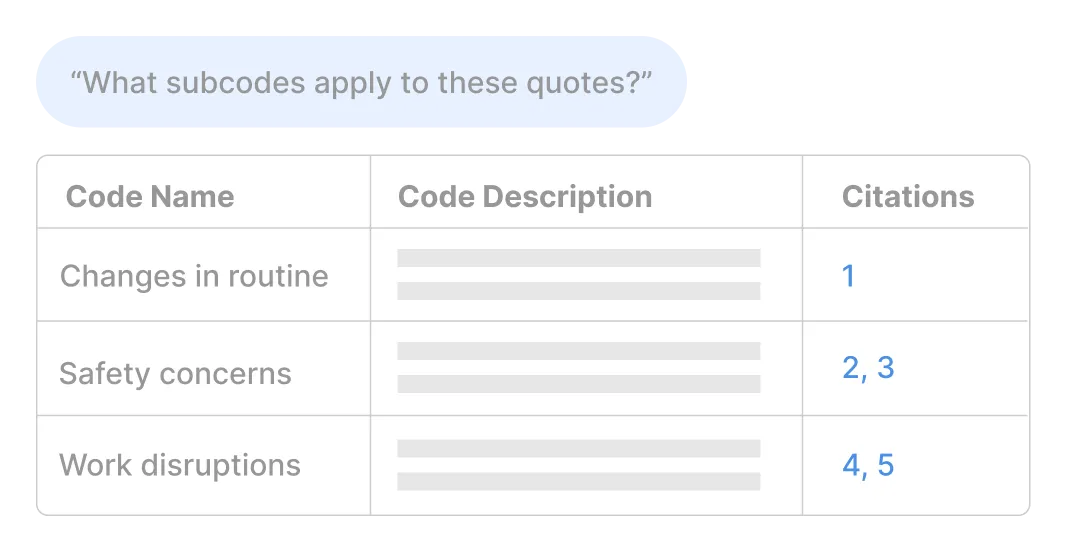
If AI suggests codes you don’t like, remove them. Remove all of them if needed without losing any progress in your actual codebook. The default is manual work. You choose when and how to bring in that AI support.
Table: ChatGPT vs. Delve AI for qualitative analysis
| What you need | Analyzing with ChatGPT | Analyzing with Delve AI ✓ |
|---|---|---|
| To verify that AI isn’t fabricating | Hallucinations are common and there’s no linked source to verify. | Answers are verifiable because they’re linked to original transcripts and source text. Possible hallucinations are called out. |
| To organize codes and themes | Manual copy/paste codes from other tools into ChatGPT | Built-in coding structure with nested codes directly in Delve AI. |
| To retain your codebook | Copy and paste from external tool into ChatGPT each time | Access your codebook in a centralized place within Delve. |
| To collaborate with your team | Manually share ChatGPT chat history back and forth. | Team members have live, real-time project access to Delve. |
ChatGPT can support moments in the process. Delve supports the process itself. The goal isn’t automation. It’s freeing you up to focus on the deeper work that makes thematic analysis so valuable.
The qualitative analysis tool recommended by researchers
“Delve helped me organize my codes into themes and reorganize them later when I needed to move specific codes to another theme.” – Susan A.
“Delve made it incredibly easy to group and categorize thoughts, themes, and ideas. The platform is intuitive and user-friendly, which allowed me to quickly identify patterns.” – Josh K.
“The best QDA platform by a mile. Excellent user interface, an easy-to-use layout, and AI chat options that work well.” – Abayomi A.
“Easy and intuitive to use. Instruction videos were super helpful. I love that you can find the evidence from different angles (e.g. from the theme or from within the transcript).” – Renate U.
“As a beginning researcher it supported me in the process of thematic analysis without automating to the extent that I did not learn the process.” – Bev C.
Try AI-assisted thematic analysis (without losing context)
Even with powerful AI tools, we believe it’s important to continue following trusted qualitative methods and methodologies from pioneers like Braun and Clarke. They provide transparency and reliability.
Delve’s AI features are built around this philosophy. AI knows your codebook and transcripts. It links suggestions to source text so you can verify. It lets you code immediately from AI suggestions and remove codes that don’t fit. You don’t automate the work, you free up time for the interpretive work.
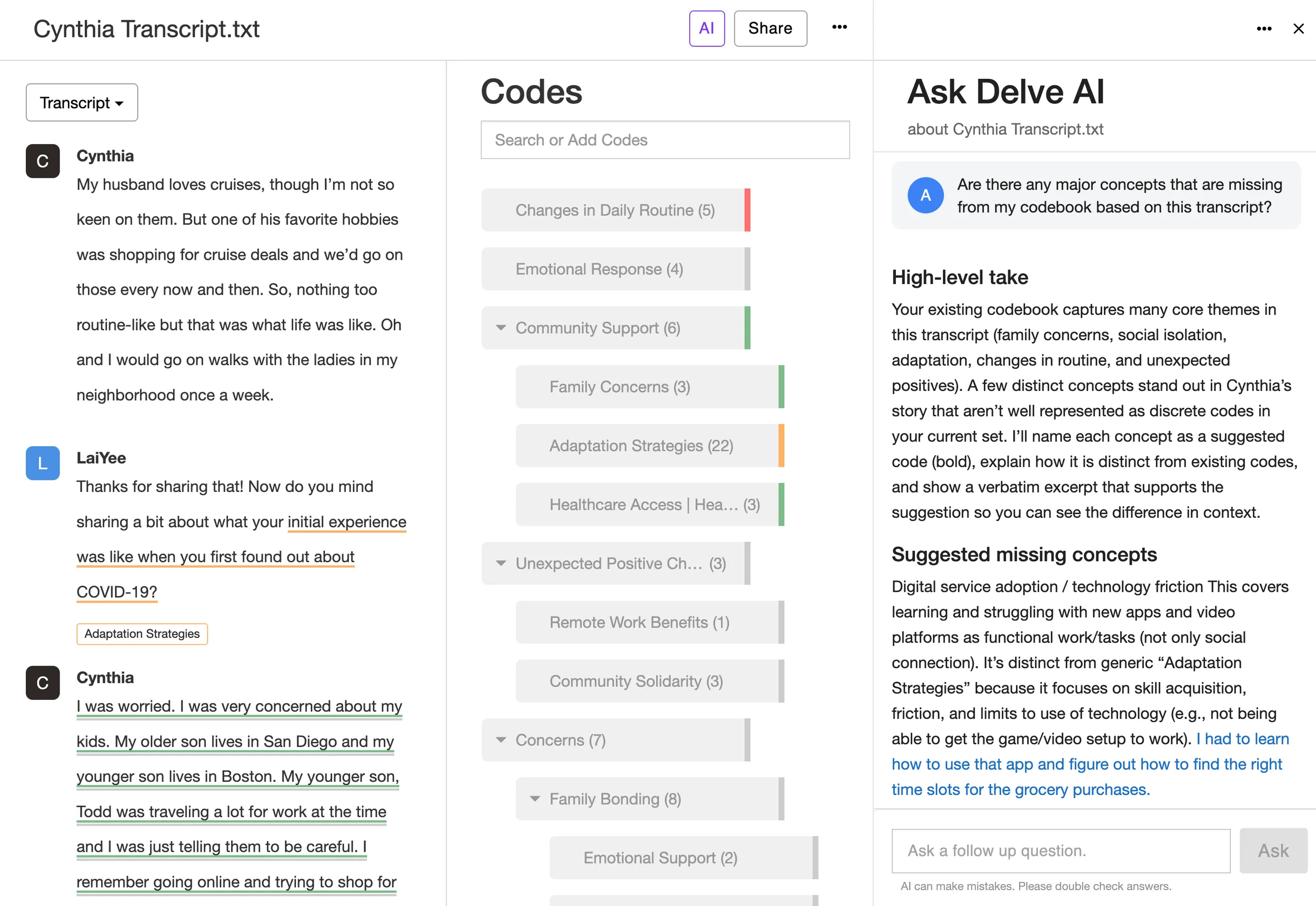
Ready to see how AI can support your thematic analysis without taking over? Try Delve free for 14 days or explore our guide to collaborative approaches in thematic analysis.

References
- Braun, V., & Clarke, V. (2006). Using thematic analysis in psychology. Qualitative Research in Psychology, 3(2), 77-101.
- Braun, V., & Clarke, V. (2022). Conceptual and design thinking for thematic analysis. Qualitative Psychology, 9(1), 3-26. https://doi.org/10.1037/qup0000196
- Cook, D. A., Ginsburg, S., Sawatsky, A. P., Kuper, A., & D’Angelo, J. D. (2025). Artificial intelligence to support qualitative data analysis: Promises, approaches, pitfalls. Academic Medicine, 100(10), 1134-1149. https://pubmed.ncbi.nlm.nih.gov/40560241/
- Liu, X., et al. (2024). Qualitative coding with GPT-4: Where it works better. Journal of Learning Analytics.
- Morgan, D. L. (2023). Exploring the use of artificial intelligence for qualitative data analysis: The case of ChatGPT. International Journal of Qualitative Methods, 22. https://doi.org/10.1177/16094069231211248
- Morgan, D. L. (2025). Query-based analysis: A strategy for analyzing qualitative data using ChatGPT. Qualitative Health Research. https://doi.org/10.1177/10497323251321712
- Naeem, M., Smith, T., & Thomas, L. (2025). Thematic analysis and artificial intelligence: A step-by-step process for using ChatGPT in thematic analysis. International Journal of Qualitative Methods. https://doi.org/10.1177/16094069251333886
- Nguyen-Trung, K. (2025). ChatGPT in thematic analysis: Can AI become a research assistant in qualitative research? Quality & Quantity. https://doi.org/10.1007/s11135-025-02165-z
- Wachinger, J., Bärnighausen, K., Schäfer, L. N., Scott, K., & McMahon, S. A. (2025). Prompts, Pearls, Imperfections: Comparing ChatGPT and a Human Researcher in Qualitative Data Analysis. Qual Health Res, 35(9), 951-966. doi: 10.1177/10497323241244669.
Cite this article
Limpaecher, A. (2026a, Feb 10). Can You Use ChatGPT for Thematic Analysis? https://delvetool.com/blog/chatgpt-for-thematic-analysis-alternatives