Qualitative analysis is usually a team effort. A lead researcher splits transcripts across assistants, two people code the same interview to check they agree, an advisor signs off on the codebook. Until now that coordination lived outside Delve, in side spreadsheets and email threads. This release brings it in: a new Transcript Dashboard to assign and track the work, in-place editing on the coding comparison page, and intercoder reliability that fits the way teams actually code.
Assign transcripts and track your team’s progress
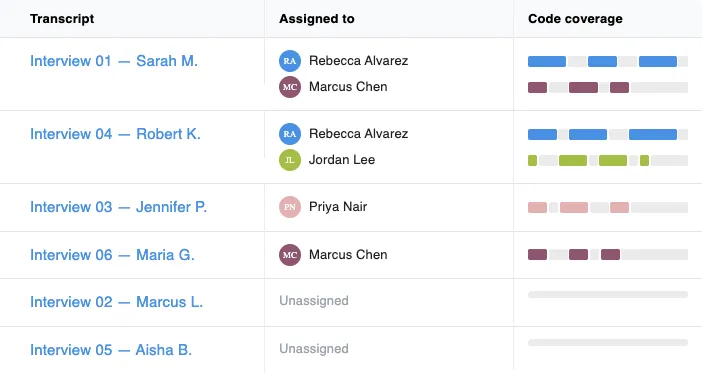
The Transcript Dashboard is one shared page for all of your project’s coding. As a lead researcher, you can assign transcripts to your team, and double-assign a transcript when you want two people to code it for reliability. No more side spreadsheet to track who’s doing what.
It earns its place when you’re coding alone, too. Jump straight back to the transcript you were last in, surface the ones you haven’t started, and sort by progress instead of an endless alphabetical list.
Delve’s AI fits in here as well. When it codes a transcript, it appears in the assigned column like any other team member, ready for you to review and accept.
Resolve disagreements right where you spot them
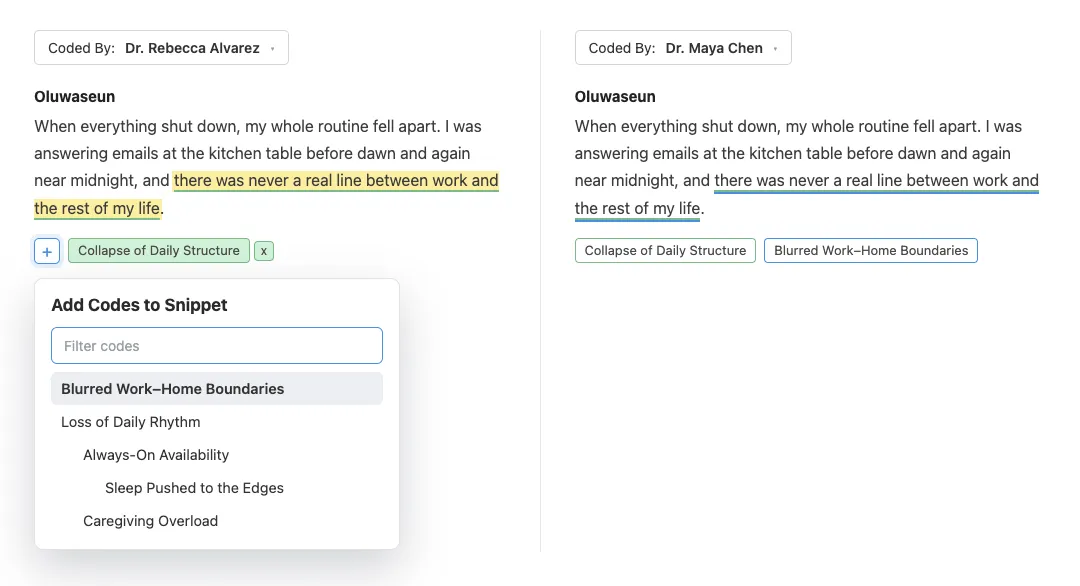
When two people code the same transcript, the comparison page shows their coding side by side. Before, fixing a disagreement meant leaving for the transcript and re-coding there. Now you can add or remove a code right on the comparison page, the moment you spot the mismatch.
Partial credit for multi-coded excerpts
Most teams apply more than one code to a passage. Before, if one person coded a passage Fear and another coded it Fear and Anxiety, your intercoder reliability score counted the whole passage as a disagreement, even though you both applied Fear. Now Delve gives partial credit for the codes you share, so a multi-coded project’s score reflects how much your team actually agrees. Single-code scoring is unchanged.
Try it with your team
A lot of this came straight from your feature requests: assigning transcripts, tracking who has coded what, fixing a code without backtracking. Thanks for sending them. Keep them coming, and we’ll keep making team coding in Delve better.
More soon,
Alex
Co-founder, Delve