This is part of our Ultimate Guide to Qualitative Software | Start a Free Trial of Delve | Take Our Free Online Qualitative Data Analysis Course
When you are doing qualitative research, someone usually asks whether your results are valid and reliable. It might be a committee member, a reviewer, or a method rubric in a textbook written mostly with quantitative work in mind. The question puts qualitative researchers in a tough spot. How do you show reliability and validity in qualitative research when you’re interpreting interviews, and not running statistics?

The short answer is that qualitative research answers the question differently. Reliability and validity are quantitative standards, and forcing them onto interpretive work asks it to be something it isn’t. Yet qualitative researchers still need to show their findings can be trusted, so Lincoln and Guba (1985) built a framework that swaps the quantitative standards for a set of criteria suited to more interpretive work.
The whole approach rests on keeping a clear record of the choices you made and why. Let’s walk through what reliability and validity mean, what qualitative research puts in their place, and where a qualitative tool like Delve helps make that record-keeping process more transparent, organized, and traceable.
Why do reliability and validity come up at all in qualitative research?
Sometimes a reviewer or professor uses “validity and reliability” loosely. Usually as shorthand for “is this research any good,” without meaning the strict quantitative versions.

Other times the expectation is literal. Fields with a strong quantitative tradition, like parts of psychology, health sciences, and education, often ask qualitative students to address validity and reliability by name, because the department’s frameworks grew up around quantitative norms. Braun and Clarke (2022) note that qualitative researchers are frequently pushed to answer to standards imported from quantitative work.
So your committee isn’t wrong to raise the terms. Reliability and validity come from a tradition that predates much of qualitative methodology, and they still carry real weight in some fields. The important part is to understand what the terms are asking for, show it the way qualitative research shows it and having the right tools to support the process.
What reliability and validity in qualitative research really mean
Reliability and validity are quantitative concepts first. In quantitative research, the two terms measure different elements of your results:
- Reliability is about consistency. A reliable measure gives you the same result under the same conditions, the way a good scale reads the same weight twice.
- Validity is about accuracy. A valid measure captures what it actually claims to measure, so a survey meant to assess anxiety measures anxiety and not, say, general stress.
Both assume a fixed, external answer, like how a scale can be wrong because there’s a true weight it’s supposed to match. But in qualitative analysis, you read transcripts and interpret what they mean through your code. Two researchers can read the same interview and reach different, equally defensible conclusions. There’s no single answer lying in wait.
Why the terms don’t transfer to reliability and validity of qualitative research
The mismatch isn’t a weakness in qualitative research. According to Braun and Clarke, it’s a difference in what the research is for.
Quantitative work aims to measure and generalize, so consistency and accuracy against a fixed benchmark make sense as standards. But qualitative work is about meaning in context, where your interpretation is part of the analysis rather than a flaw to remove. Braun and Clarke describe this as working reflexively, staying aware of how your own perspective shapes that interpretation by writing memos instead of pretending it isn’t there.
Lincoln and Guba make a similar argument and offer a replacement. Rather than force qualitative work through quantitative criteria, they proposed a parallel standard built for interpretive research: trustworthiness. Meeting that standard comes down to keeping clear reflexive memos, which a qualitative tool like Delve makes easier by keeping your memos (and codebook) organized and tied to the data.
What replaces reliability in qualitative research: The criteria of trustworthiness
Reliability and validity both fall under what quantitative researchers call rigor. Trustworthiness is the qualitative answer to rigor, and each of its four criteria has a quantitative counterpart. The diagram below shows where reliability and validity fit:
Reliability maps to dependability. Where reliability asks whether a measure repeats, dependability asks whether your process was consistent and documented well enough that another researcher could follow your decisions and see you applied them the same way throughout. You establish it by keeping a clear, traceable record of how you coded, not by reproducing an identical result. Delve organizes the process by giving you one place to document those decisions and keep the record as your analysis develops.
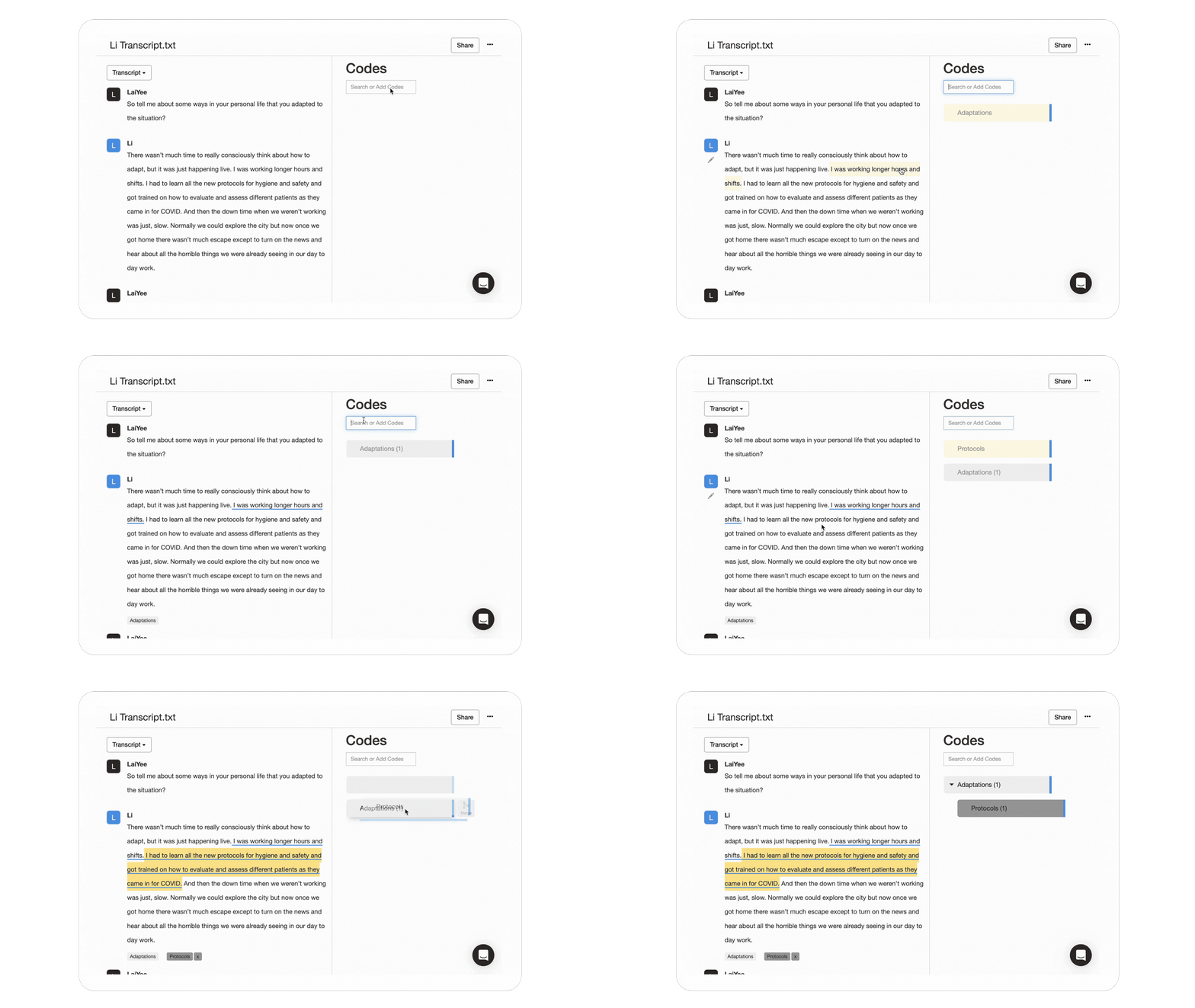
Validity maps to credibility. Where validity asks whether you measured the right thing, credibility asks whether your analysis reflects your participants’ reality. You build it with methods like member checking, where you take your findings back to participants, and peer debriefing, where an outside colleague pressure-tests your interpretation. In Delve, you can share a project directly with participants or a colleague, which makes it easier to run member checks and peer debriefing.

For the other two criteria, confirmability asks whether your findings come from the data rather than your own bias, which you support through reflexivity and documenting how your perspective shaped the analysis. Transferability gives readers enough context to judge whether your findings fit their own setting. Learn how all four work together in our guide to trustworthiness in qualitative research.
Showing dependability in qualitative research with Delve
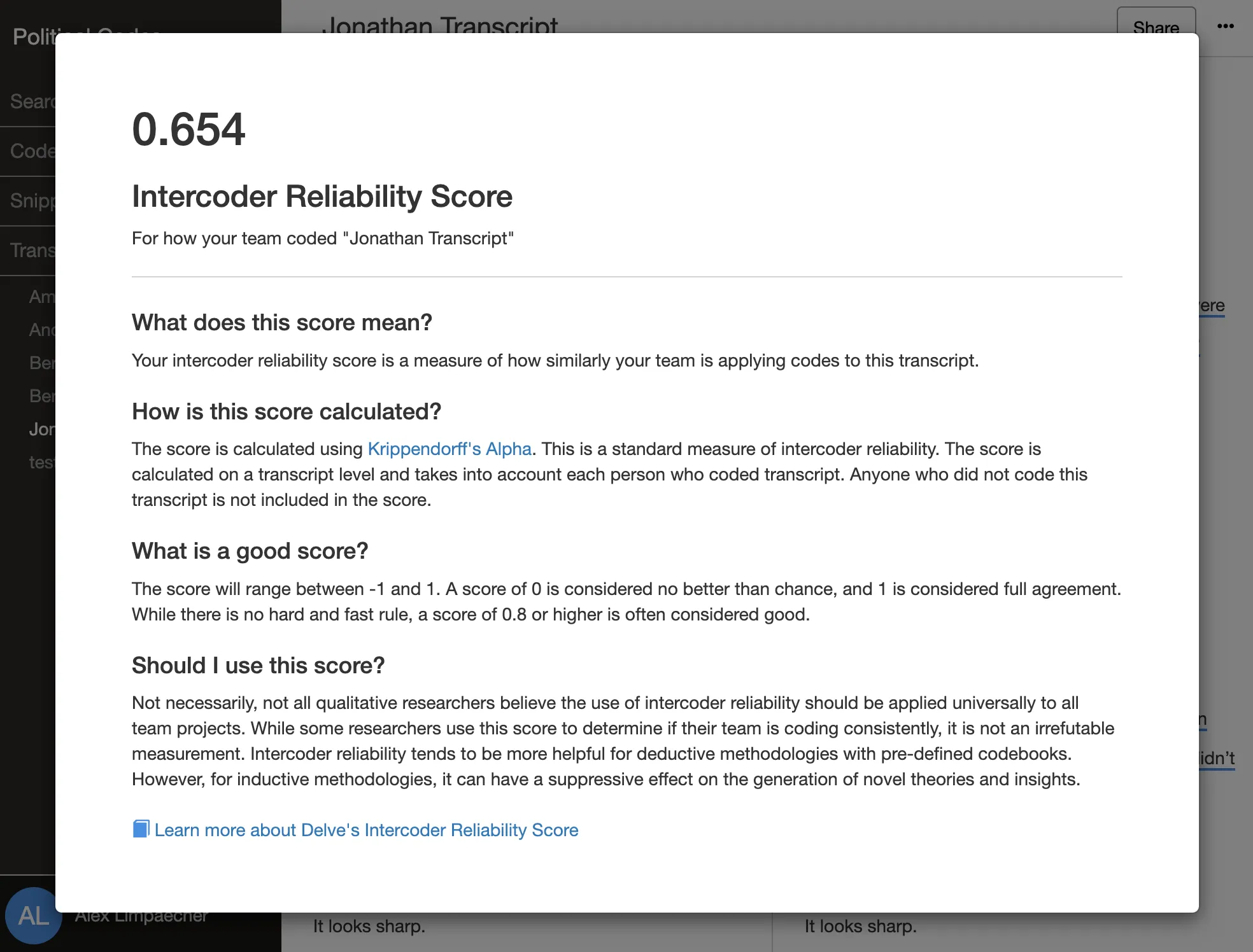
Dependable qualitative research is well-documented from start to finish. To show your research process was consistent, you need a clearly defined codebook, memos about how your codebook changed, and why. On a team, you also need to show that different coders applied codes the same way, which is what intercoder reliability measures, and where consensus and split coding come in.
| Quantitative term | What it asks | Qualitative equivalent | How you show it | Where Delve helps |
|---|---|---|---|---|
| Reliability | Does the measure repeat under the same conditions? | Dependability | A documented, traceable record of your coding decisions; intercoder reliability and consensus coding on a team | Your codes and memos stay linked to the transcript excerpts they came from, and intercoder reliability updates automatically as a team codes |
| Validity | Does it measure what it claims to? | Credibility | Member checking and peer debriefing, testing your interpretation against participants and outside colleagues | Share a project with a participant or colleague at view-only or edit access to run member checks and peer debriefs |
Holding all of that together in a pile of spreadsheets, scattered documents, and half-remembered decisions turns the record-keeping process into its own second job. The analysis might be sound, but proving it to someone reviewing your results is much easier with centralized project files. Delve keeps that record intact by connecting each decision to the data behind it:
- Your codes and memos stay attached to the transcript excerpts they came from, so any conclusion traces back to its source.
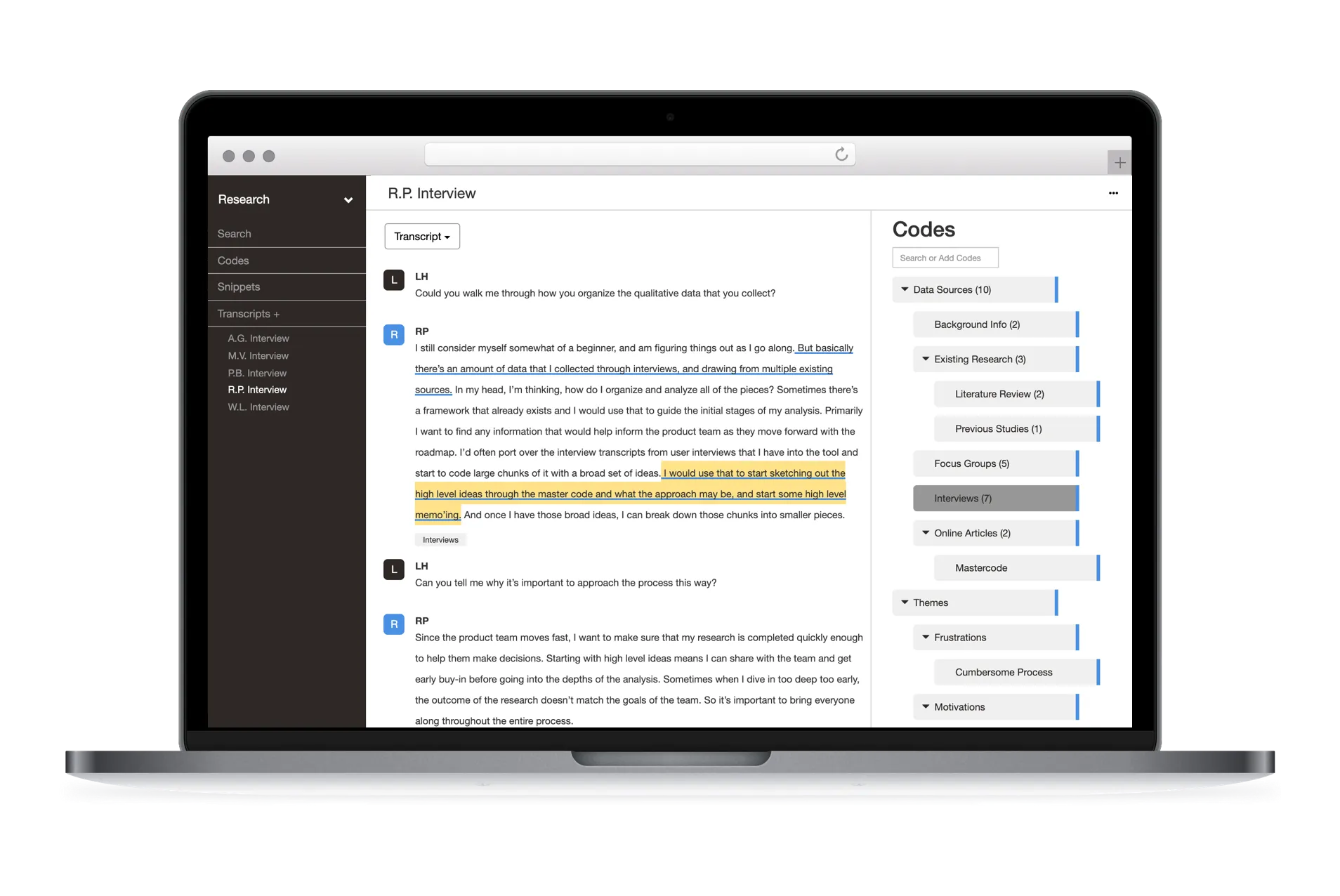
- Your codebook lives in one place as it evolves, with every change documented rather than remembered.
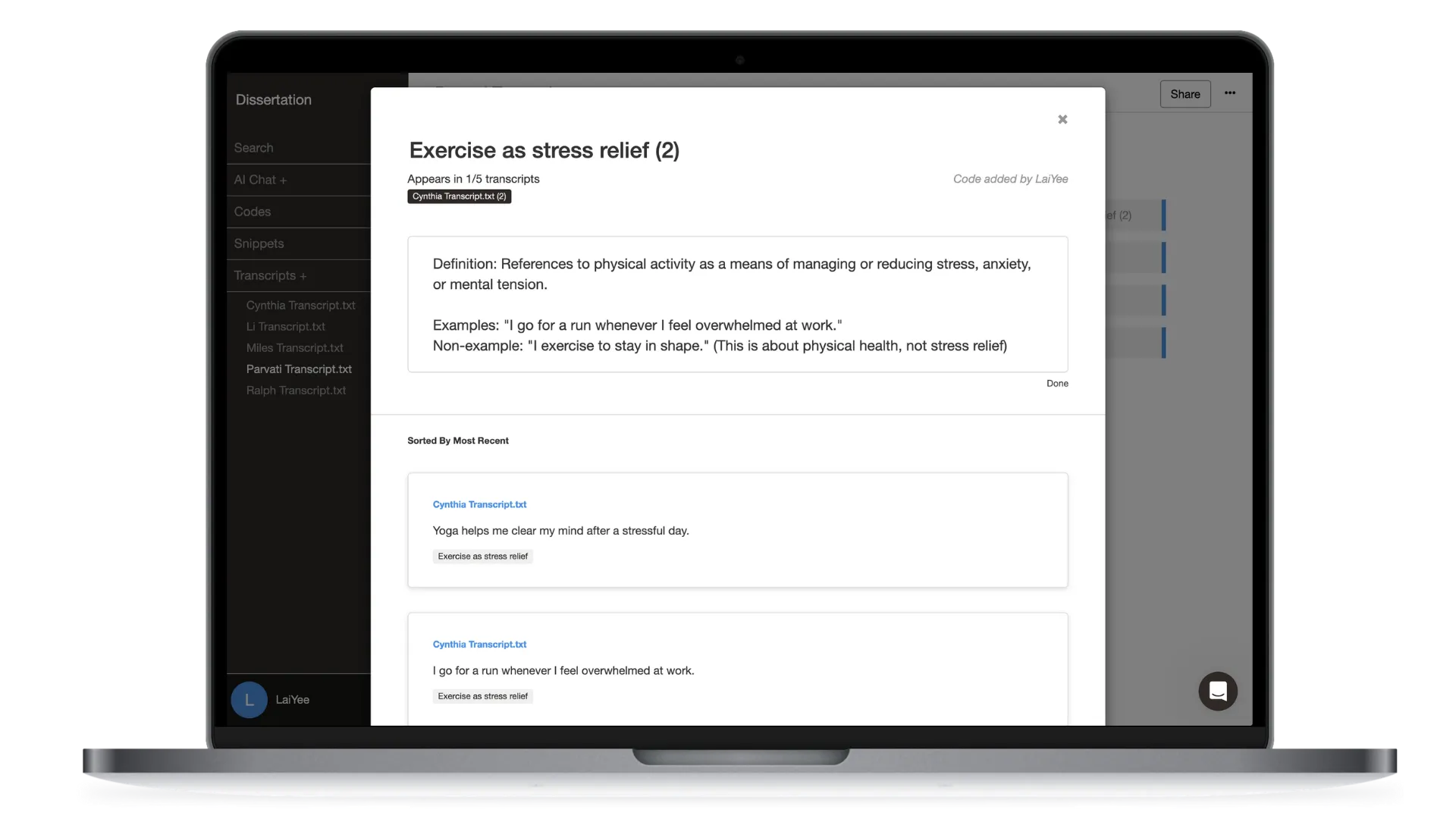
- On a team project, intercoder reliability updates as you code, so you check consistency as you go rather than at the end.
This kind of organization holds up in real doctoral work. Dr. Katherine Miller used Delve to code more than 18 hours of recordings for her University of Pennsylvania dissertation, sorting and refining her codes in one place before she successfully defended.
Reliability and validity aren’t the wrong instinct for qualitative work, they’re just not the best words for describing qualitative work.. What your committee is really asking is whether your findings can be trusted, and you answer that by keeping a process you can actually show.
Start a free 14-day trial of Delve and build a reliable research process you can stand behind.
Frequently asked questions
What is the difference between reliability and validity in qualitative research? Reliability and validity are quantitative terms, so qualitative research uses different criteria in their place. Reliability, which measures whether results repeat consistently, maps to dependability in qualitative work. Validity, which measures whether you captured what you intended, maps to credibility. Lincoln and Guba (1985) grouped these qualitative criteria under the broader goal of trustworthiness.
Can qualitative research be reliable and valid? Yes, but it demonstrates those qualities differently than quantitative research does. Rather than proving a measure repeats or matches a fixed benchmark, qualitative research shows dependability through a documented, traceable process and credibility through methods like member checking and peer debriefing. The underlying goal is the same: showing the findings can be trusted.
What is the qualitative equivalent of reliability? Dependability is the qualitative equivalent of reliability. Where reliability asks whether a measure produces the same result under the same conditions, dependability asks whether your research process was consistent and documented well enough that another researcher could follow your decisions. You establish it by keeping a clear record of how you coded and why, not by reproducing an identical result. Tools like Delve support this by keeping your codebook and coding decisions in one traceable place.
What is the qualitative equivalent of validity? Credibility is the qualitative equivalent of validity. It asks whether your analysis accurately reflects your participants’ reality. Researchers build credibility through member checking, where findings are shared back with participants, and peer debriefing, where an outside colleague reviews the interpretation.
How do you ensure reliability in qualitative research? You ensure reliability, understood as dependability, by documenting your process thoroughly. This means keeping a record of every coding decision, tracking how your codebook evolves, and, on a team, checking that different coders apply codes consistently through intercoder reliability or consensus coding. A shared workspace like Delve makes this documentation easier to maintain and show, since intercoder reliability calculates automatically and every code stays linked to its original data.
What are the four criteria of trustworthiness? The four criteria of trustworthiness are credibility, dependability, confirmability, and transferability. Lincoln and Guba (1985) proposed them as the qualitative counterparts to the standards used in quantitative research. Credibility corresponds to internal validity, dependability to reliability, confirmability to objectivity, and transferability to generalizability. Together they offer a framework for evaluating qualitative work on its own terms. You can read more in our guide to trustworthiness in qualitative research.
Why don’t reliability and validity apply to qualitative research? Reliability and validity assume a fixed, external answer to measure against, which qualitative research doesn’t have. Because qualitative analysis interprets meaning, two careful researchers can read the same data and reach different but equally defensible conclusions. Braun and Clarke (2022) note that forcing quantitative standards onto qualitative work judges it against a benchmark it was never designed to meet.
Is intercoder reliability necessary in qualitative research? Intercoder reliability is useful but not universally required. It measures how consistently multiple coders apply the same codes and is often expected in team-based or deductive research, and by some journals. For inductive, interpretive work, it can be less appropriate, since some variation in coding reflects legitimate interpretive depth rather than error. When it is needed, tools like Delve calculate it automatically as a team codes.
References
- Lincoln, Y. S., & Guba, E. G. (1985). Naturalistic inquiry. SAGE Publications. https://books.google.com/books/about/Naturalistic_Inquiry.html?id=25lpzgEACAAJ\
- Braun, V., & Clarke, V. (2022). Thematic analysis: A practical guide. SAGE Publications. https://uk.sagepub.com/en-gb/eur/thematic-analysis/book248481
Cite this article
Delve, Ho, L., & Limpaecher, A. (2026). Reliability and validity in qualitative research: what they mean and what replaces them. https://delvetool.com/blog/reliability-validity-in-qualitative-research