This is part of our Ultimate Guide to Qualitative Software | Start a Free Trial of Delve | Take Our Free Online Qualitative Data Analysis Course
When you do qualitative research, a committee member, peer debriefer, or collaborator eventually asks the same question: “How do you know your interpretation is right?” When it comes time to defend your findings, there are a few ways to establish trustworthiness in how you arrived at those answers.
Where quantitative analysis measures against numbers qualitative work asks you to read transcripts and interpret what they mean. Two researchers might read the same interview and reach different, but equally defensible interpretations. Both might have valid insights, which makes the work valuable and also harder to verify than a column of numbers. Trustworthiness is how you reinforce those findings.
This article covers what each criterion asks for and the methods that prove them, including how a tool like Delve keeps a record of your coding decisions as you go, so you can show your trustworthiness holds up instead of piecing it together at the end.
Establishing trustworthiness without “hard data”
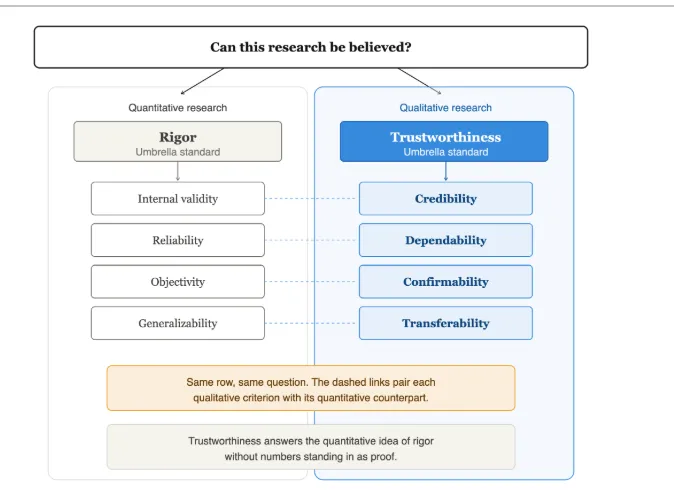
On its own, “trust” just means something you can rely on, but this pair used it more specifically. Lincoln and Guba (1985) established four criteria to tell whether your qualitative results can be trusted. Where quantitative research uses the term rigor for findings that hold up to scrutiny, their criteria is the qualitative equivalent. The goal is to back up your findings without numbers or “hard data” as proof.
Bias is a hard word to pin down in qualitative research, because your perspective is built into the work. A nurse studying patient experiences of chronic pain brings clinical knowledge, professional context, and an ear for how patients describe their symptoms. That background can strengthen the analysis. “Researcher bias” is when you arrive at findings without ever examining how you got there. It only becomes a problem when it shapes what gets coded without stopping to question why.
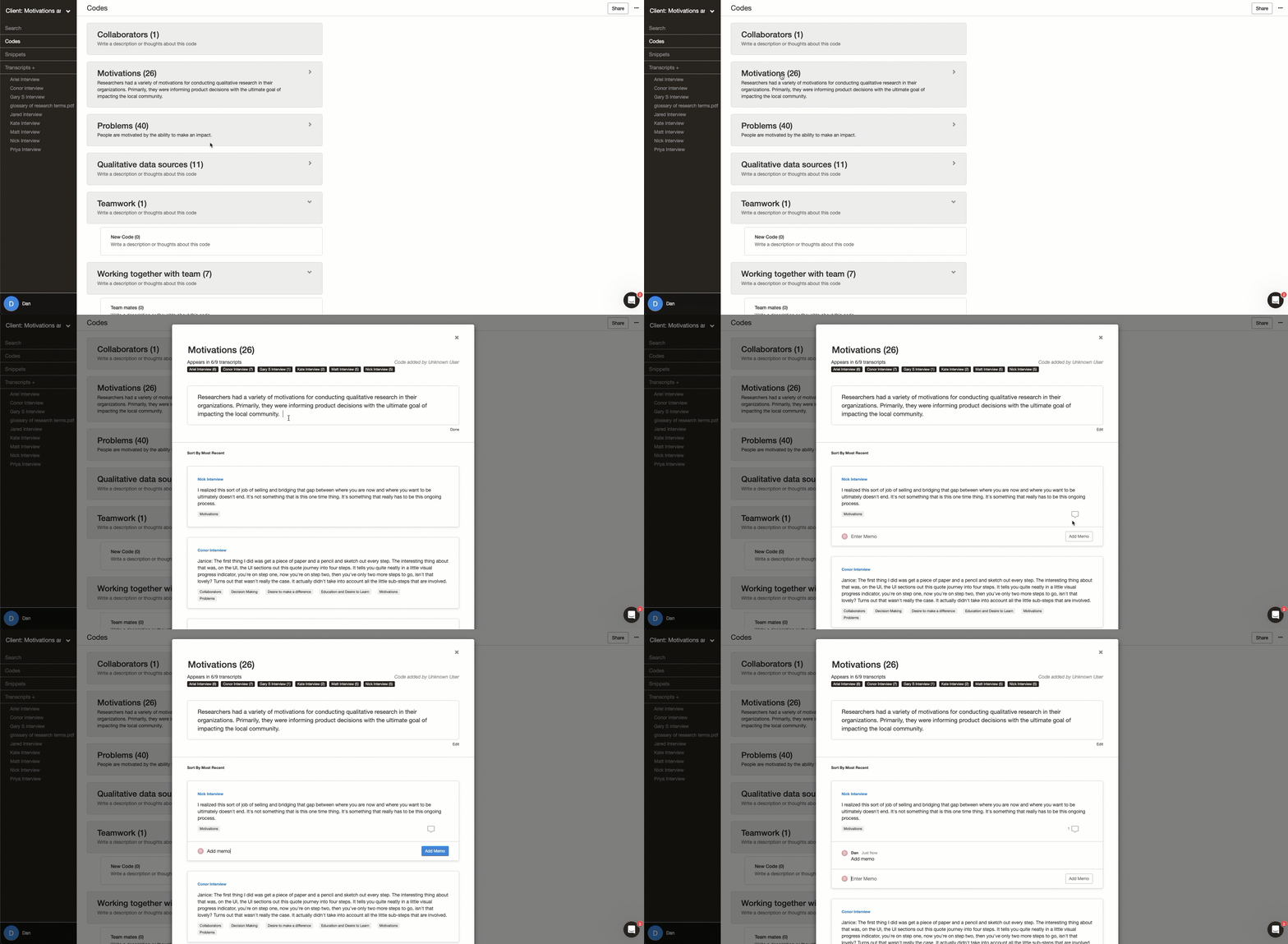
Reflexivity is the process of engaging with your own decision-making to avoid that blind spot, and memos record your open dialogue with yourself and your data to let others trust how you got there.You gain a lot from writing memos as you work, but tracking them down later often means digging through spreadsheets or loose pages. Delve is a qualitative tool that timestamps every memo you make and pins it to the snippet that prompted it. Across tens or dozens of transcripts, your reasoning always stays attached to the data instead of drifting out of sight and out of mind into a separate file outside the project.
Regardless of the tools you use, the overarching point of trustworthiness isn’t to sterilize your own insights. You’re just being clear about where your judgment came into play by using the four criteria of trustworthiness for qualitative researchers.
Four criteria of trustworthiness in qualitative research
Lincoln and Guba built each of these criteria as a qualitative counterpart to a standard that quantitative research already relied on. Their argument was that qualitative work shouldn’t be judged by tools made for a different kind of science. They proposed each criterion specific to qualitative research:
- Credibility – Does your analysis reflect your participants’ reality?
- Dependability – Can your process be traced and trusted?
- Confirmability – Did you account for your own influence?
- Transferability – Can others judge whether your findings apply elsewhere?
Remember that these criteria aren’t there to eliminate your voice or perspective. As we’ll see, they give you a way to show that your interpretive process was thorough, transparent, and grounded in the data.
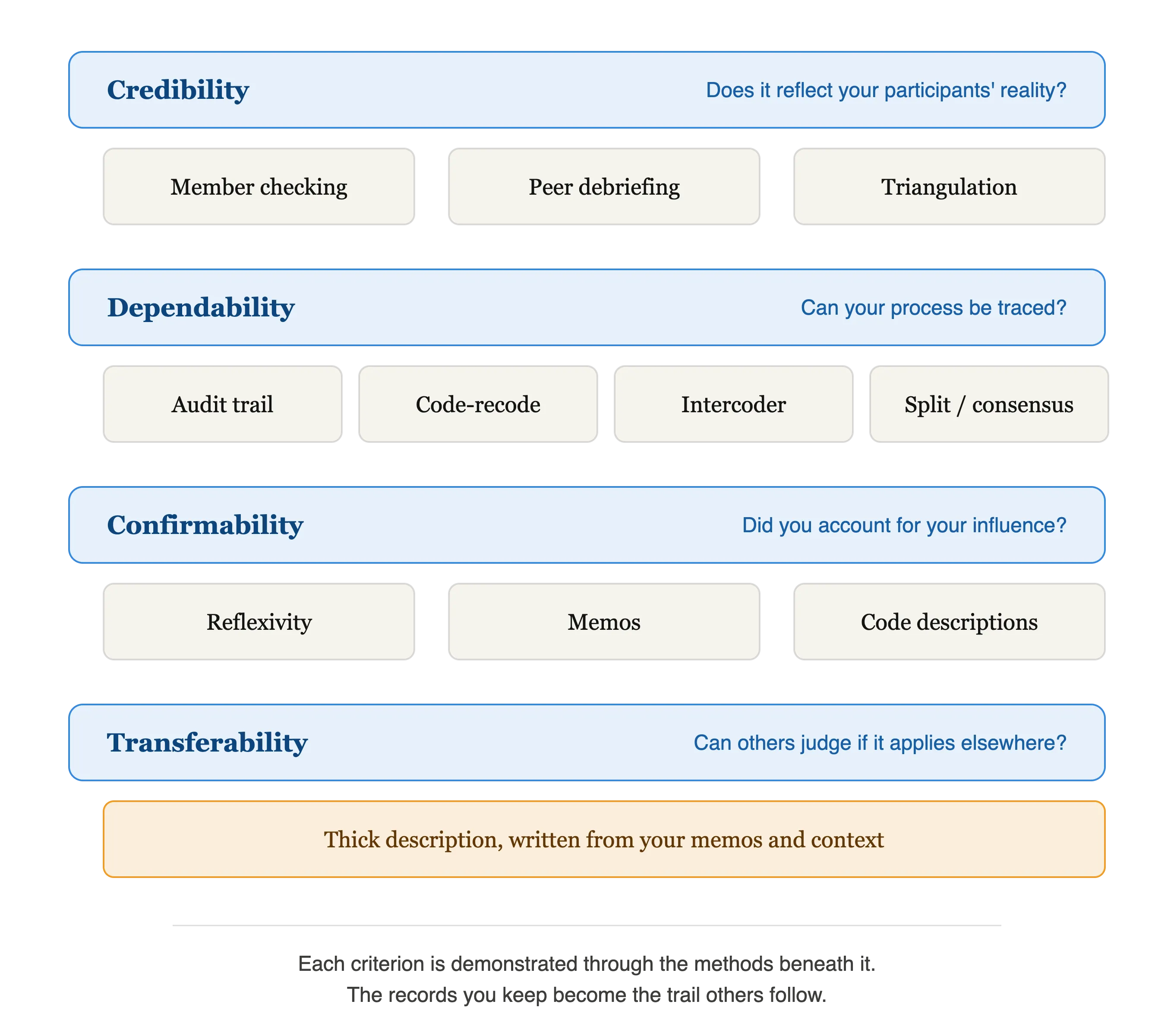
Validity in quantitative research asks whether a measure captures what it claims to. Trustworthiness in qualitative research asks whether findings are credible, consistent, and grounded, given that more than one valid interpretation can exist.
Credibility in qualitative research: Does your analysis reflect your participants’ reality?
Credibility asks whether you got the analysis right from your participants’ point of view, and there are a few ways to demonstrate that. Each method tests your interpretation against something outside your own head, whether that’s the participants, a colleague, or another data source.
The more your reading holds up against those outside perspectives, the more credible it becomes, which is why Lincoln and Guba grouped these techniques under credibility. Three of them do most of the work:
- Member checking tests your reading against the participants themselves. You share your findings and ask whether your interpretation matches their experience, which is one of the most direct ways to confirm you didn’t misread what people were telling you. By using a qualitative tool like Delve, you can share your analysis with your research participants and get their thoughts on it. Lincoln and Guba called member checking the single most important technique for credibility.
- Peer debriefing tests it against an outside colleague with no stake in the project. A good debriefer catches the places where your perspective shaped the analysis without you noticing. Tools like Delve make this straightforward, since you can share your full project with a debriefer and give them view-only or edit access just like Google Drive. We’ll also cover AI peer debriefing later.
- Triangulation tests it against other data sources, methods, or even other researchers. When separate researchers analyzing the same data reach similar conclusions, that agreement adds weight to your results, like a GPS triangulating a position by crossing several signals at once.
Dependability in qualitative research: Can you trace your thinking process?
Agreement also points to a consistent process, and consistency is dependable. Where credibility is about your findings, dependability is about how you reached them. It asks whether your process was documented well enough that another researcher could follow your decisions and see that you applied them consistently. Think of it as an audit trail, a term Lincoln and Guba borrowed from financial auditing, where an outside reviewer can read your records and trace the path you took to your results.
Documenting your codebook is the foundation, whether you code alone or work with a team. Clear code definitions hold it all together, letting you or anyone on your team apply a code the same way on the first transcript and the thirtieth. You refine them as you go, catching smaller details on each pass.
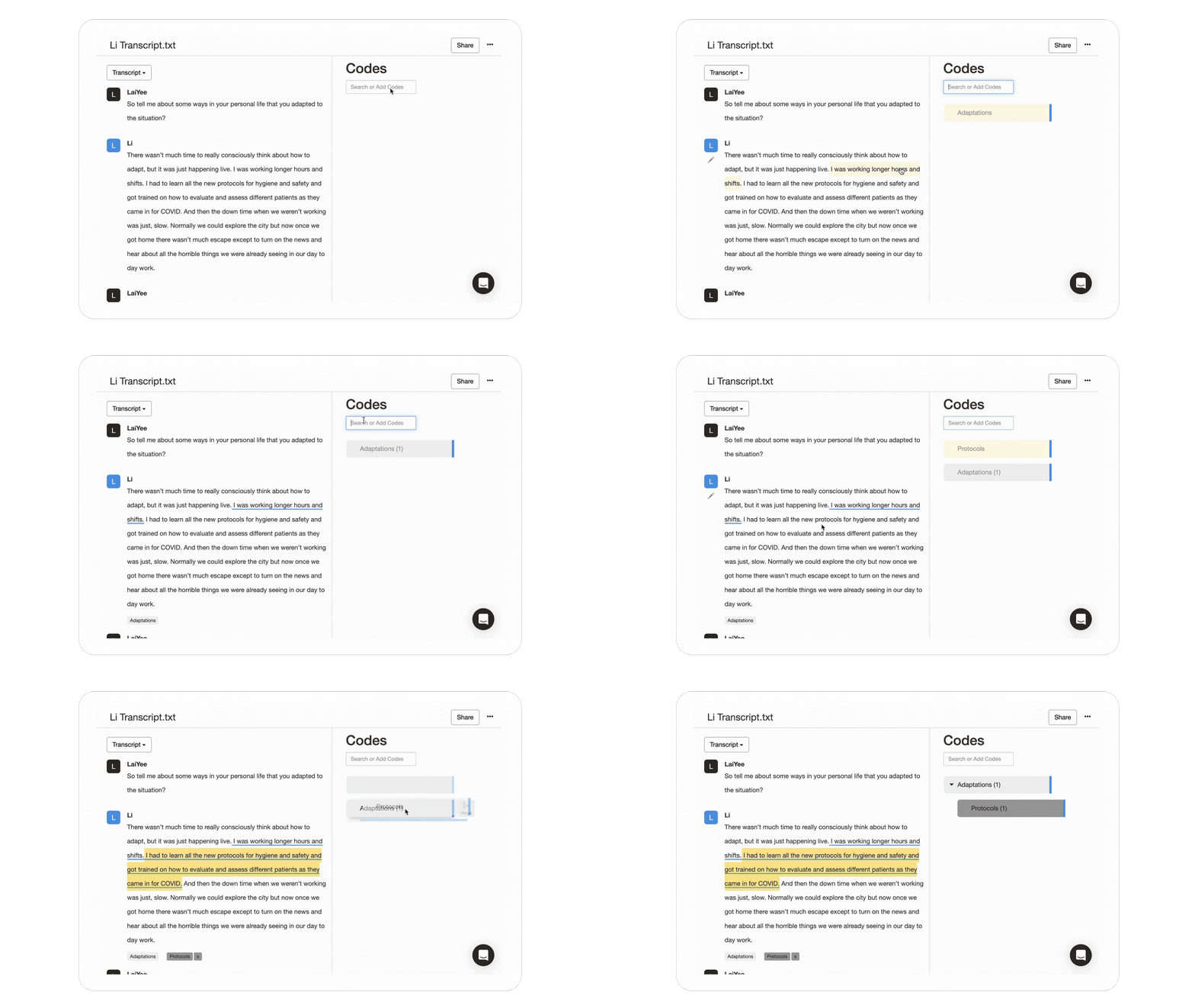
[Highlight text, add codes, and nest sub-codes in Delve with drag and drop functionality.]
Memos capture why a definition changed, so the reasoning stays on the record instead of in your head.
On your own, Lincoln and Guba’s code-recode check is a simple way to test consistency. You code a section, set it aside, then recode it later and see whether you match yourself. Once a team is involved, intercoder reliability measures how consistently different coders apply the same codes, which some journals expect before publication. Split and consensus coding are two other ways to work through disagreements and agree on how a code should be applied.
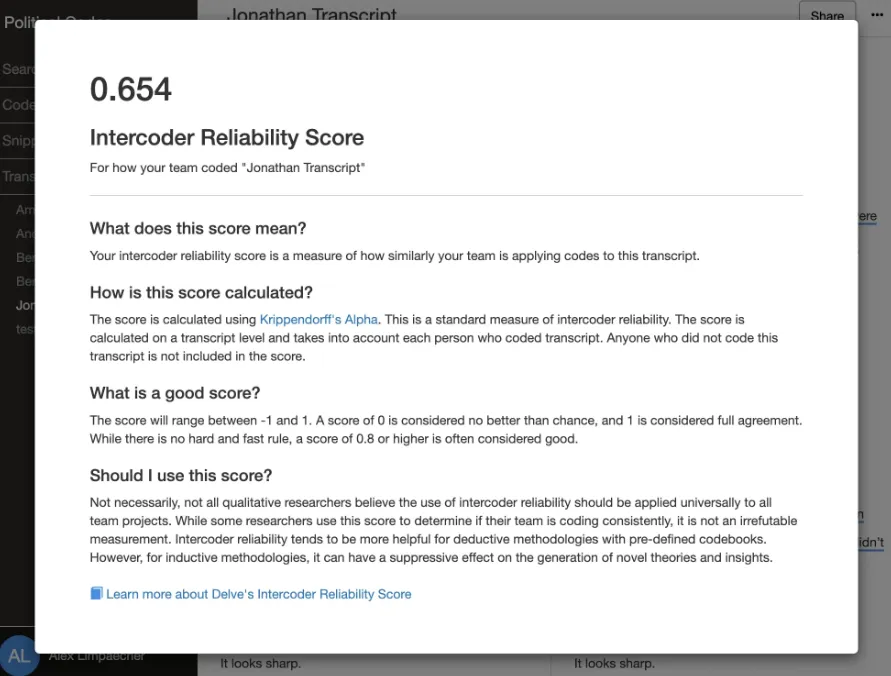
[Delve calculates intercoder reliability automatically, showing how consistently your team applied your codebook.]
Delve makes it easier to show you are being consistent. Your team codes in one shared project where you can see who coded what, or hide their coding to work solo first, then compare. Intercoder reliability updates as you code, leaving a record another researcher can follow to see the process held together.
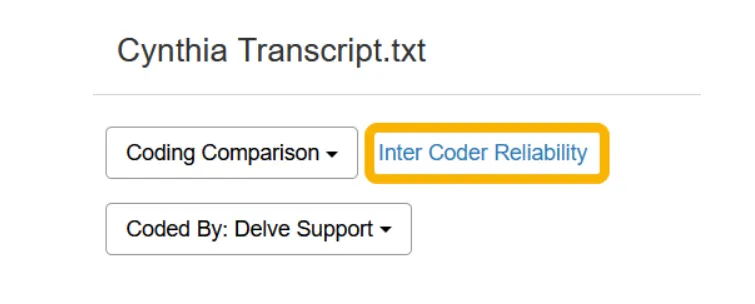
[In Delve, you can compare how different coders applied codes across the same transcript.]
Confirmability in qualitative research: Accounting for your own influence
Confirmability returns to the question of perspective we started with. It asks whether your findings come from the data rather than from your own preferences. Braun and Clarke are clear that erasing your perspective isn’t the goal. Being transparent about how it shaped the work is, and that’s where reflexivity becomes a record you can use in your write-up. In Delve, you build that record two ways as you code.
The first is a memo. You can attach one to any snippet to capture an assumption, a reaction, or a decision you weren’t sure about, pinned to the exact line of text that raised it so you keep ideas connected.
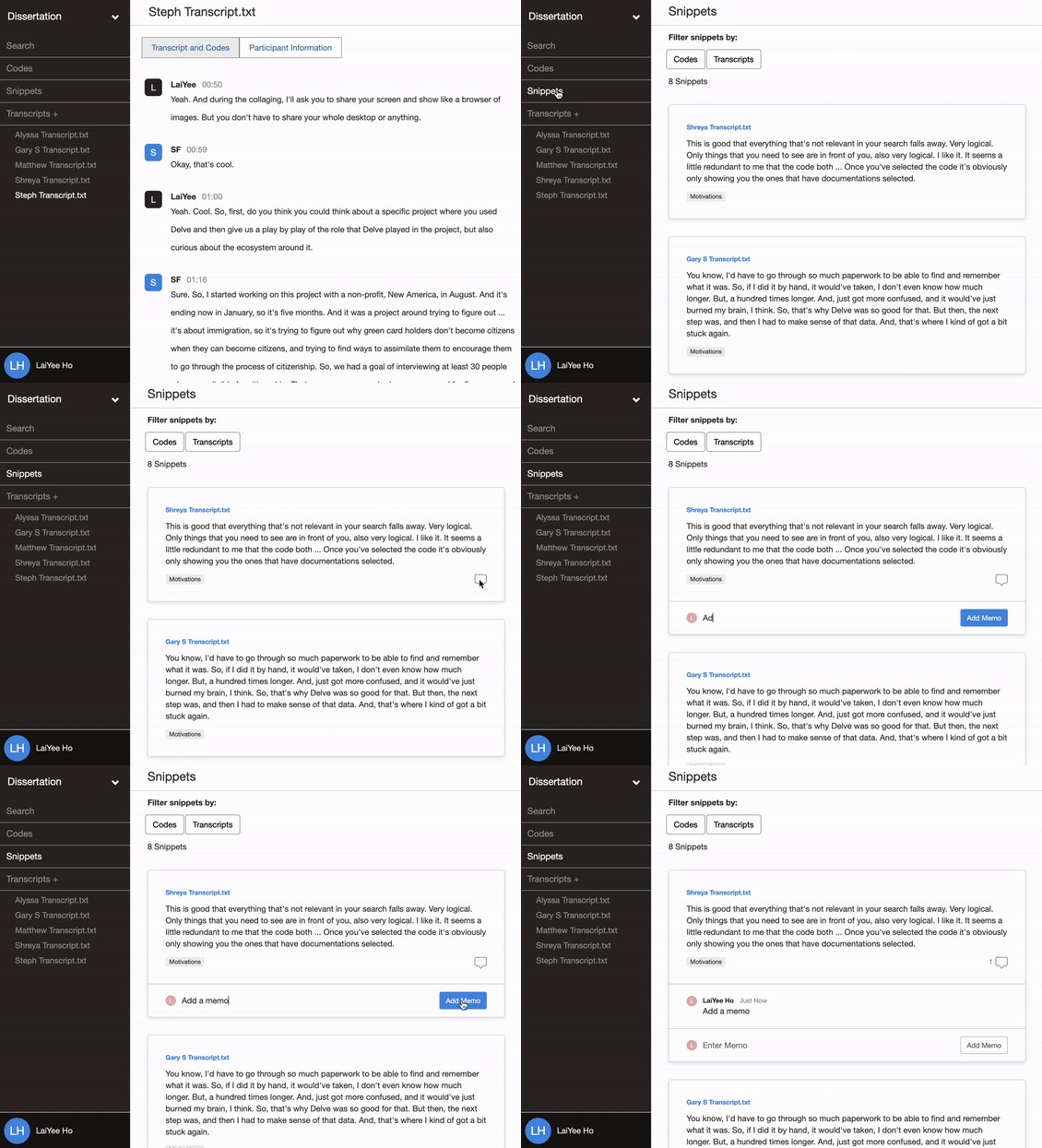
[A codebook in Delve keeps a record of how and why your coding changed over time.]
The second is the code description. Where a memo tracks your thinking about one snippet, a description documents what a code means and why it exists, which keeps a team applying it consistently. These definitions also guide Delve’s AI coding assistant.
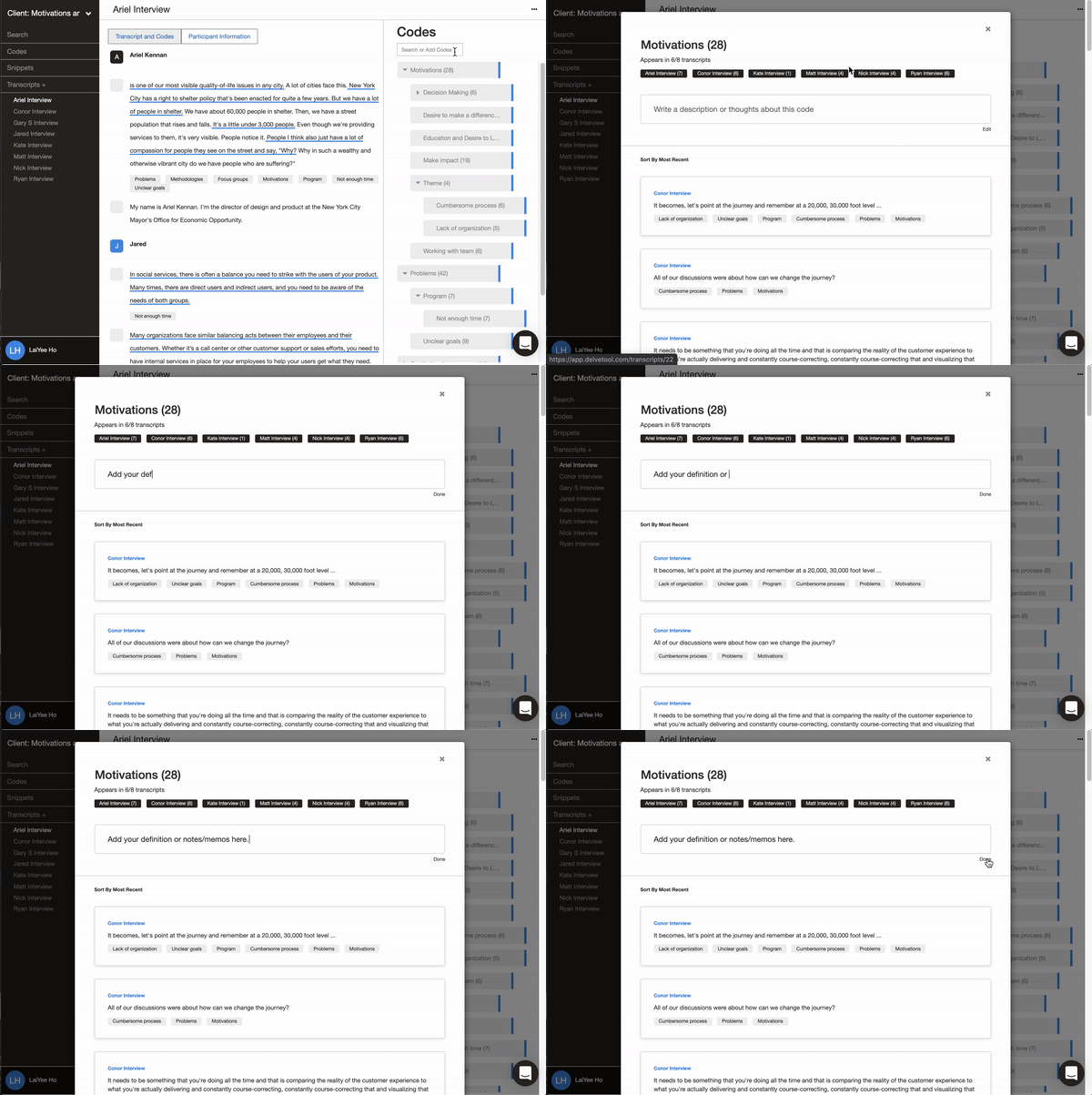
[A code description documents what the code captures across the project in Delve.]
Taken together, memos and code descriptions leave whoever reviews your work a running account of how your thinking developed, so you can always follow a conclusion back to the original data behind it.
Transferability in qualitative research: Giving others enough to judge
Transferability is the odd one out. The other three are checks you run during your project. This one is a writing responsibility. Dependability records how you worked, but transferability describes the setting itself, your participants, context, and methods, in enough depth that someone else can judge whether your findings carry over. That depth is what qualitative researchers call “thick description.”
This is the qualitative answer to generalizability. A quantitative study claims its findings apply to a wider population, and the burden of proof sits with the researcher making that claim. Transferability moves the burden to the reader. You’re not claiming your results apply everywhere. You describe your context fully enough that readers can decide for themselves whether the findings fit their own setting.
The detailed memos and context you record while coding become the raw material for that account, which is one more reason to keep them somewhere organized rather than scattered.
Establish trust when AI is involved in qualitative research
AI tools are increasingly part of qualitative workflows, which raises a new version of the question we opened with. If AI helped generate or apply codes, how do you (and your readers) know the analysis is still yours?
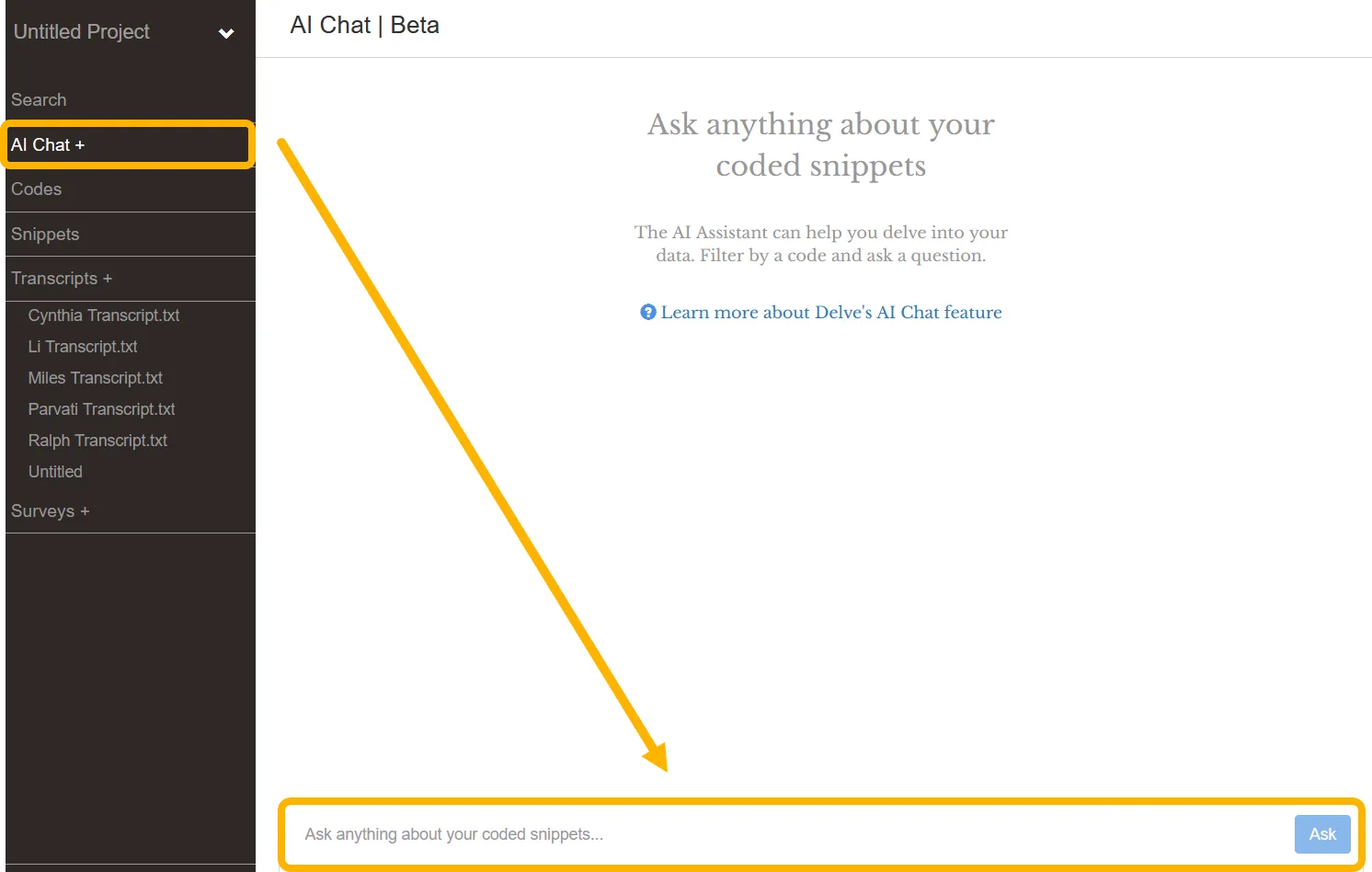
[Delve’s AI Chat answers questions about your coded snippets and links each response back to the source.]
The principle hasn’t changed. You stay at the center of the decision-making, and AI works like an assistant to suggest codes, summarize transcripts, flag patterns, and even apply your codebook. The audit trail matters even more here, because every big decision needs to trace back to your own human judgment. In Delve specifically, the AI features are built to support all four criteria of trustworthiness.
Credibility. All of your AI suggestions link back to your source text, so you can check a proposed code against the quote it came from instead of trusting it blind. When a human peer debriefer isn’t on hand, the AI can serve as an early sounding board, and because it keeps a record of the exchange, you hold onto a track of what you questioned and why.

Dependability. Like memos, your codes stick to the snippets they came from, and snippets stay attached to their transcripts, so nothing you or the AI applied gets separated from its original data source. Your process is then traceable end to end without flipping through multiple files or locations.

Confirmability. When you use Apply Codes Using AI, the tool deductively applies codes from your descriptions and records why it made each decision in that snippet’s memo. That’s the same field you’d use for your own notes, so everything stays together and the record you’d want for confirmability builds itself as you work. If you disagree or change your mind, you can easily remove codes applied by AI.
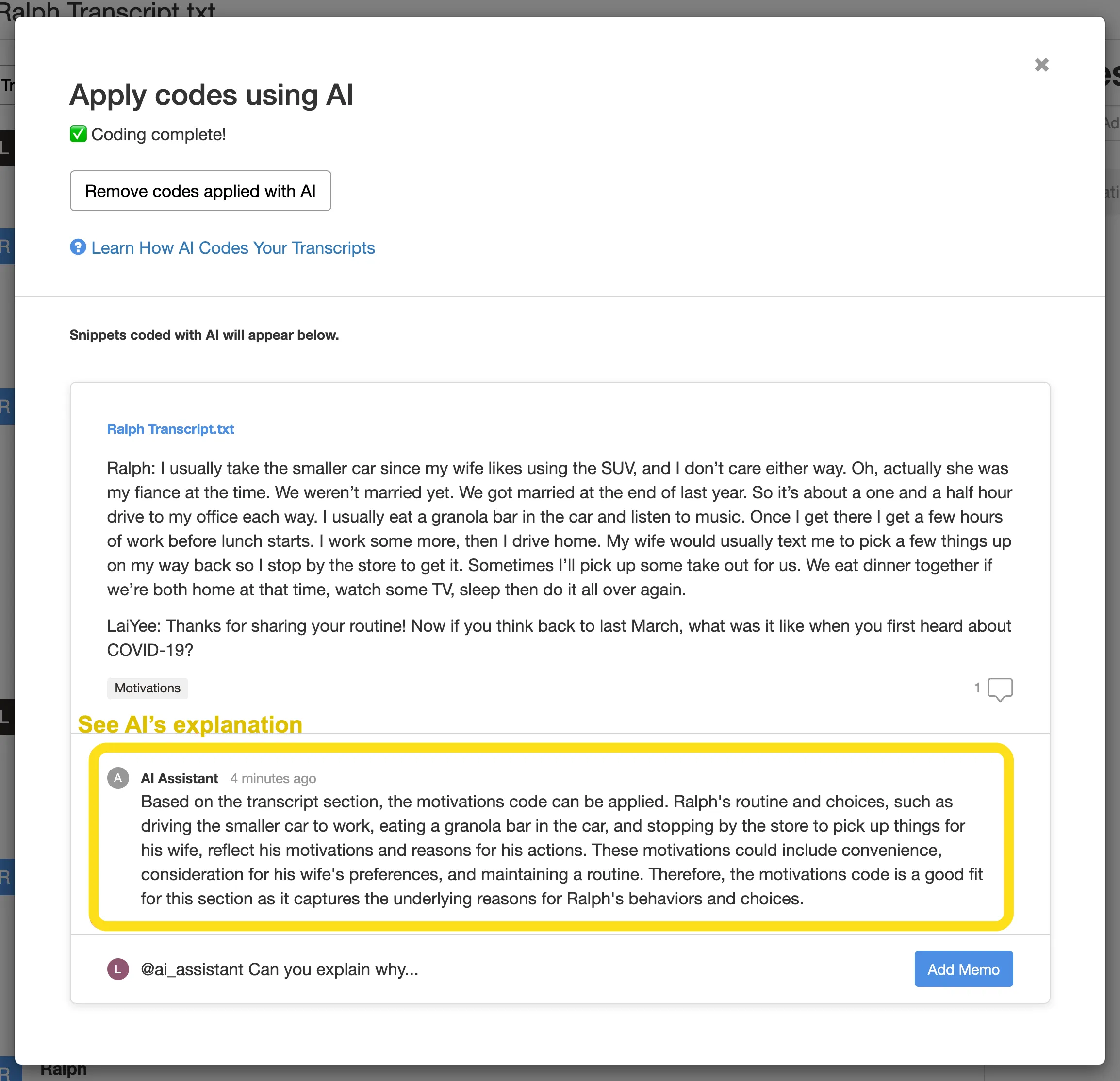
Transferability. Whether you write a memo or the AI logs its reasoning, that detail accumulates as you work. When it’s time to write up your study, that information feeds into the thick description a reader needs to decide whether your findings fit their own setting.
Whether or not you bring AI into your qualitative analysis, the four criteria we’ve covered depend on you staying organized enough to prove the work behind them. The trouble starts when those trails are scattered across folders, files, team members, and your own memory.
Where trustworthiness breaks down, Delve can help
Member checking, peer debriefing, intercoder reliability, memos, code descriptions, coding comparisons all need a shared, organized place for your work to live. When transcripts sit in folders, codes sit in spreadsheets, and notes get scattered across emails, trustworthiness is harder to establish. The analysis might be sound, but proving the underlying trustworthiness is its own job.
| Criterion | What it asks | How you demonstrate it | In Delve | With AI |
|---|---|---|---|---|
| Credibility | Does your analysis reflect your participants’ reality? | Member checking, peer debriefing, and triangulation, each a check against an outside perspective | Share a project with a debriefer at view-only or edit access | Suggestions link to the source text, so you can verify each code against its quote |
| Dependability | Can your process be traced and trusted? | An audit trail of your decisions. Code-recode checks on your own, intercoder reliability and split or consensus coding on a team | Every code stays linked to its snippet, and every snippet to its transcript, so you can trace any finding back to the source | Apply Codes Using AI cites the snippets it based each decision on |
| Confirmability | Did you account for your own influence? | Reflexivity, recorded through memos and code descriptions | Memos on snippets and a description for each code | AI explanations land in that same memo field, on the record |
| Transferability | Can others judge whether your findings apply elsewhere? | Thick description, your context written up in enough depth for readers to judge | Memos give you the context and detail to write your thick description | AI can help you brainstorm and draft that thick description |
Delve fills that organizational gap. You can share a project with a peer debriefer, calculate intercoder reliability automatically, and keep memos attached to the snippets that prompted them as your thinking develops. The collaboration tools support researcher triangulation without the coordination overhead, and the AI can act as a sounding board whenever you want a second read on a coding decision.
Trustworthiness is how you answer the question of whether your interpretation holds up, and the answer comes far more easily when your process is something you can demonstrate in Delve.
Start a free 14-day trial of Delve and build a more organized, defensible research process.
Frequently asked questions
What is the difference between reliability and validity in qualitative research? Reliability and validity are quantitative terms, so qualitative research uses different criteria in their place. Reliability, which measures whether results repeat consistently, maps to dependability in qualitative work. Validity, which measures whether you captured what you intended, maps to credibility. Lincoln and Guba (1985) grouped these qualitative criteria under the broader goal of trustworthiness.
Can qualitative research be reliable and valid? Yes, but it demonstrates those qualities differently than quantitative research does. Rather than proving a measure repeats or matches a fixed benchmark, qualitative research shows dependability through a documented, traceable process and credibility through methods like member checking and peer debriefing. The underlying goal is the same: showing the findings can be trusted.
What is the qualitative equivalent of reliability? Dependability is the qualitative equivalent of reliability. Where reliability asks whether a measure produces the same result under the same conditions, dependability asks whether your research process was consistent and documented well enough that another researcher could follow your decisions. You establish it by keeping a clear record of how you coded and why, not by reproducing an identical result. Tools like Delve support this by keeping your codebook and coding decisions in one traceable place.
What is the qualitative equivalent of validity? Credibility is the qualitative equivalent of validity. It asks whether your analysis accurately reflects your participants’ reality. Researchers build credibility through member checking, where findings are shared back with participants, and peer debriefing, where an outside colleague reviews the interpretation.
How do you ensure reliability in qualitative research? You ensure reliability, understood as dependability, by documenting your process thoroughly. This means keeping a record of every coding decision, tracking how your codebook evolves, and, on a team, checking that different coders apply codes consistently through intercoder reliability or consensus coding. A shared workspace like Delve makes this documentation easier to maintain and show, since intercoder reliability calculates automatically and every code stays linked to its original data.
What are the four criteria of trustworthiness? The four criteria of trustworthiness are credibility, dependability, confirmability, and transferability. Lincoln and Guba (1985) proposed them as the qualitative counterparts to the standards used in quantitative research. Credibility corresponds to internal validity, dependability to reliability, confirmability to objectivity, and transferability to generalizability. Together they offer a framework for evaluating qualitative work on its own terms.
Why don’t reliability and validity apply to qualitative research? Reliability and validity assume a fixed, external answer to measure against, which qualitative research doesn’t have. Because qualitative analysis interprets meaning, two careful researchers can read the same data and reach different but equally defensible conclusions. Braun and Clarke (2022) note that forcing quantitative standards onto qualitative work judges it against a benchmark it was never designed to meet.
Is intercoder reliability necessary in qualitative research? Intercoder reliability is useful but not universally required. It measures how consistently multiple coders apply the same codes and is often expected in team-based or deductive research, and by some journals. For inductive, interpretive work, it can be less appropriate, since some variation in coding reflects legitimate interpretive depth rather than error. When it is needed, tools like Delve calculate it automatically as a team codes.
References
Lincoln, Y.S. and Guba, E.G. (1985) Naturalistic Inquiry. SAGE, Thousand Oaks, 289-331.
http://dx.doi.org/10.1016/0147-1767(85)90062-8
Braun, V., & Clarke, V. (2022). Thematic analysis: A practical guide. SAGE. https://us.sagepub.com/en-us/nam/thematic-analysis/book248481
Nowell, L. S., Norris, J. M., White, D. E., & Moules, N. J. (2017). Thematic analysis: Striving to meet the trustworthiness criteria. International Journal of Qualitative Methods, 16(1). https://doi.org/10.1177/1609406917733847
Saldaña, J. (2016). The coding manual for qualitative researchers (3rd ed.). SAGE.
Cite this article
Delve, Ho, L., & Limpaecher, A. (2026). Trustworthiness in qualitative research: What it means and how to demonstrate it. https://delvetool.com/blog/trustworthiness-in-qualitative-research