This is part of our Ultimate Guide to Qualitative Software | Start a Free Trial of Delve | Take Our Free Online Qualitative Data Analysis Course
You finished coding and you’re confident in your codes, themes, and findings. Then a committee member or peer debriefer asks how you know your reading of the transcripts is right. They aren’t asking whether you worked hard, but whether your interpretation matches what your participants meant.
Credibility is how you show your work holds up to scrutiny by testing your analysis against people who can push back. Maybe a participant reacts to your summary, a colleague disagrees with how you coded something, or a field note or memo contradicts an interview.
Then months later, you have to find all of it again to write up. The participant’s reply is in an email thread, the debrief notes are in a Word doc, and the observation that changed your reading is in a journal. None of it links to the transcripts it belongs to. Below are the six techniques that establish credibility, what each one tends to produce, and how a qualitative analysis tool like Delve organizes the entire process.
What credibility in qualitative research means
When a committee chair refers to the “credibility of qualitative research,” they are asking whether the findings represent the participants’ reality in the study. Lincoln and Guba (1985) proposed it as the first of four trustworthiness criteria, and it is a counterpart for what quantitative research calls internal validity.
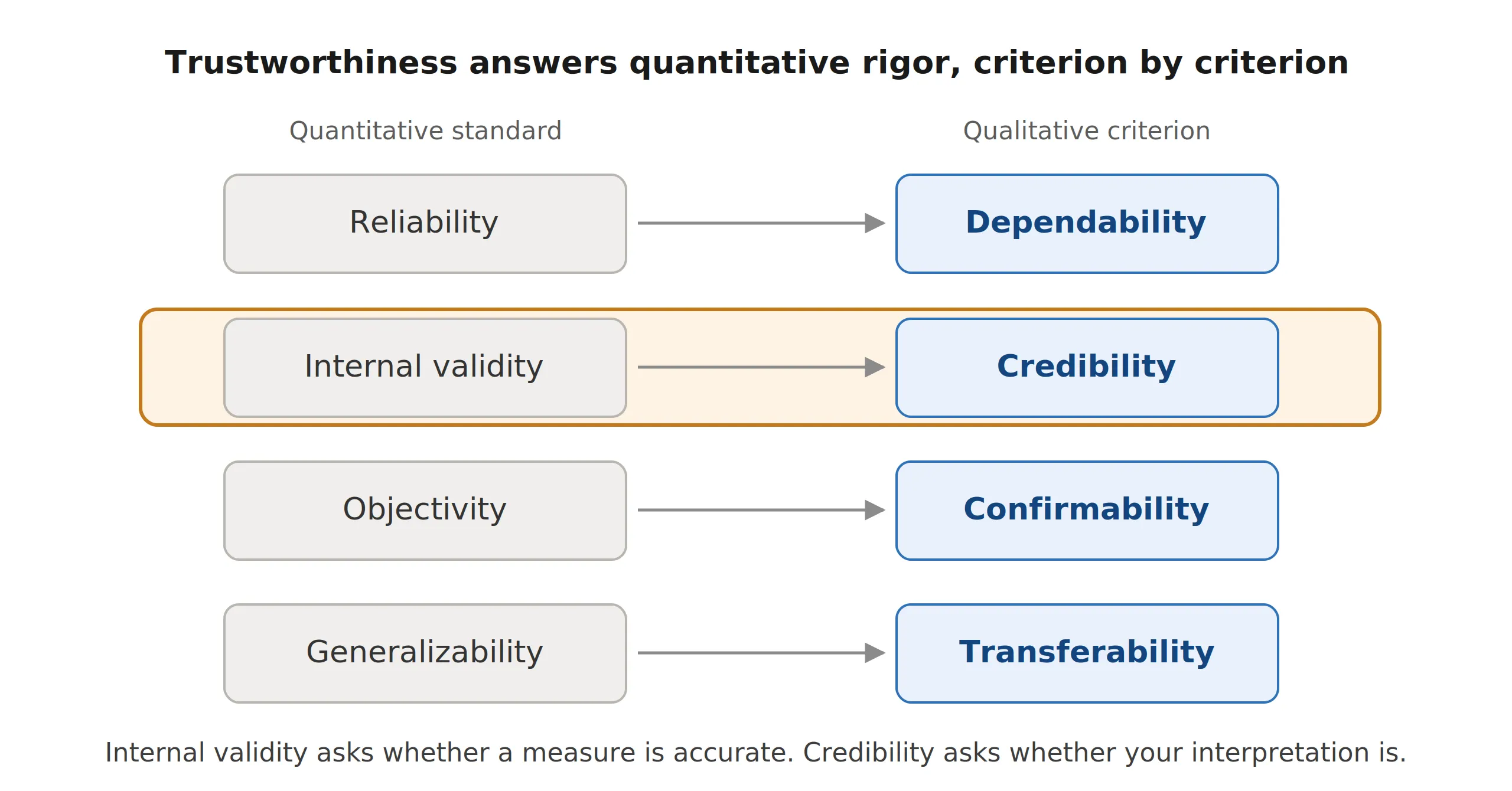
Table 1: Four criteria of trustworthiness answer different questions about your qualitative research process
| Criterion | What it asks | What it points at |
|---|---|---|
| Credibility | Does your analysis reflect your participants’ reality? | Your findings |
| Dependability | Can your process be traced and trusted? | Your process |
| Confirmability | Did you account for your own influence? | You, yourself |
| Transferability | Can others judge whether your findings apply elsewhere? | Your reader |
[Lincoln and Guba’s four criteria of trustworthiness and the question each one answers.]
The four criteria divide the work of establishing trust in your results. Dependability covers your process, confirmability covers your own influence, transferability covers what your reader needs to judge fit, and credibility covers the findings themselves. Three of these you can satisfy without anyone else’s input. The audit trail, the reflexive notes, and the description of your setting are records you keep yourself, and writing memos as you code in a tool like Delve is where most of them come from.
Credibility is different in that it asks for a quality test you can’t produce alone. Whether your reading of a participant’s experience is accurate is a question that participant can help you answer, or a colleague reading the same data, but not you sitting with your own notes. Show them your codes and themes and the passages underneath, then record what comes back against those same passages. We’ll walk through the six techniques they suggest for doing this as we go.
.gif)
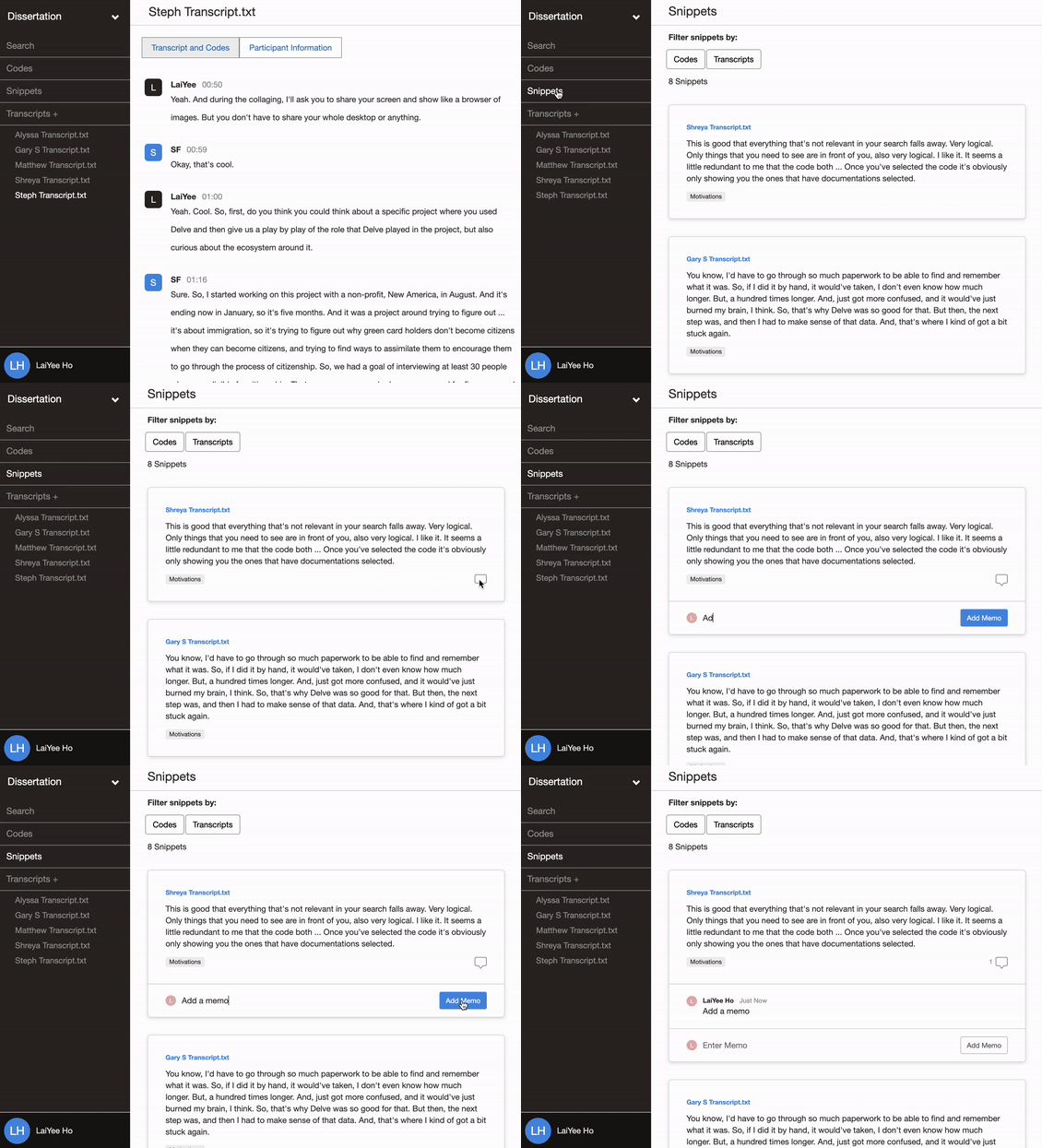
Using a shared qualitative project in Delve makes it easier to organize feedback as it comes in. A debriefer opens your project and follows any theme down to the coded passages underneath it in your Code Pages. Bringing someone in to read your work is free in Delve, since only people who code alongside you need a subscription.
Six ways to establish credibility in qualitative research
Lincoln and Guba named a handful of techniques for building credibility. They work best together, since each one covers a different weak point where something may question the credibility of your work:
- Prolonged engagement. Spend enough time in the setting that people stop performing for you. This is about months in the field rather than a longer interview. Early on you get the tidy version of someone’s experience, and time teaches you the setting well enough to notice when something sounds off.
- Persistent observation. Prolonged engagement gives you breadth. Observation gives you depth. You return to the details carrying the most meaning instead of collecting a little of everything.
- Triangulation. Check a finding against a second source, method, or analyst. An interview, a document, and a field note pointing the same direction beats any one of them alone. Researcher triangulation applies the same logic to people.
- Peer debriefing. A colleague with no stake in your conclusions reads your themes and pushes on them. The useful version means letting them trace a theme back to the passages behind it, rather than summarizing your findings over coffee.
- Negative case analysis. You go looking for the data that contradicts your theme. Either the theme changes to account for it, or you explain why the exception exists. If you don’t look for negative cases, a theme can survive simply because nothing in your data was ever asked to challenge it.
- Member checking. Share your interpretation with participants and ask whether they recognize themselves in it. The framework treats this as the most direct test available, since the people who lived the experience are the ones who can say whether you read it right.
Lincoln and Guba designed these tools to look for outcomes that complicate your initial reading. A negative case tells you there’s more to learn, so you can code it as an exception and Delve keeps them together for when you come back. Maybe a debriefer helps most when they disagree. A member check often does its job when a participant tells you that you got something wrong.
🗒 Coding a disconfirming case
"The weekly check-ins were the most useful part of the whole program."1 Four of the six participants described the check-ins in similar terms. "Honestly I stopped going once the semester got busy. Nobody seemed to notice."1,2
Codes:
1 Check-ins valued – Participants describe the weekly meetings as helpful
2 Disconfirming case – An account that runs against the emerging theme
Keep that in mind agreement isn’t proof. A participant might agree because they trust you, or because arguing with a written summary feels rude. Decide before you start what you’ll do when someone disagrees, and when they do, write a memo in Delve on the specific code snippets they’re disputing so the objection is attached to the code it belongs to.
Examples of credibility in qualitative research: When the interview and the observation disagree
Let’s look at an example of how to establish credibility of qualitative research in a real study. Dado, Spence and Elliot (2023) followed eight fellows placed in rural Ghanaian communities for a 10-month agricultural education fellowship.
One of the researchers spent three months living among them, visiting their community placements and staying at the program house during monthly training sessions. She ran individual interviews and focus groups in month seven, kept a reflexive journal the entire time, and held a final focus group after the fellows returned to the United States. The interviews and the observations told three contradictory stories.
Table 2: What fellows said vs. what the researcher observed
| What fellows said in interviews | What the researcher observed |
|---|---|
| They wanted more structured monthly meetings with a defined purpose | When a structured schedule arrived, they pushed back and asked for free time to go to the market or do laundry |
| They wanted more feedback on their classroom teaching | When the program arranged for a pedagogical expert to review recordings of their classes, several who had asked for it wanted to know whether it was required and said they’d rather skip it |
| They wanted clear numeric benchmarks from the program | When they got numbers, they pushed to change them, and separately said they disliked being told how to run their classrooms |
The interviews weren’t the problem. That final focus group served as the member check, and nobody walked back the request for structured meetings, so the fellows meant what they said both times.
But nothing in the transcripts would have revealed the gap. The insight came from the reflexive journal and the field notes, and it held up because those entries were dated against the interview timeline. That ruled out the simplest explanation, that the fellows had changed their minds over the course of the year. The authors ran seven credibility strategies in total, and this is the one that caught it.
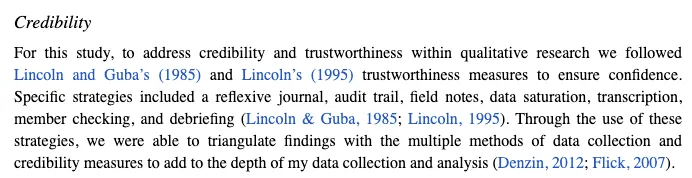
The seven credibility strategies Dado and colleagues used, as reported in their methods. From Dado, Spence and Elliot (2023), International Journal of Qualitative Methods, CC BY-NC 4.0.
A contradiction like that could easily read as unreliable data. The authors reported it as a finding instead, because they had enough evidence to interrogate the gap rather than guess at it. That’s what a full set of credibility measures can add to your results. They found the gap by matching a dated journal entry to a specific interview months later. In Delve you’d attach that observation to the passage as a memo instead, so the contradiction is visible the moment you open the transcript.
Challenge: Keeping your credibility evidence together
Let’s look at the reflexive journal the researchers used. They gave it a table of contents linking every date to its entry, built by hand, because they knew they’d need to match a specific observation against a specific interview months later. Without that index, the “Contradictions” theme would have fallen apart.
A lot of what they saw happened in passing, with no recording running, so anything they didn’t write down soon after was gone or half-remembered by the time they needed it. Your project has the same problem at a smaller scale.
Unless you use a qualitative tool like Delve, each credibility technique you run produces a record, and those records land in different places:
- The debrief notes sit in a shared doc somewhere online.
- The member check is buried in an email thread.
- The observation that changed your mind is a journal entry from four months ago.
- The theme it supports is in your codebook, three rounds of coding later.
By the time you write your methods section, you’re rebuilding the index the researcher built as she went. Whatever you can’t find doesn’t make the paper, which means the checks you ran stop counting as evidence.
Write a credibility section you can stand behind
Using qualitative software like Delve keeps all of your credibility record keeping in one project, so the results are already assembled when you sit down to write.
.gif)
Having that data changes what you can write up. Most methods sections offer a list like we triangulated, we ran member checks, and we debriefed with a colleague. The stronger version reports what each check found, the way the Ghana authors did when they wrote up the contradiction rather than burying it.
Table 3: Where credibility tends to fall apart, and how to hold it together
| Credibility technique | Where the record slips | How Delve helps |
|---|---|---|
| Persistent observation | Field notes drift into a separate file, disconnected from the passage they complicate | A Delve memo attaches to the snippet that prompted it, timestamped as you write |
| Peer debriefing | Your debriefer reads a summary and has no way to check it against the actual data | Share your qualitative coding project so they can read your codes and themes, and trace the evidence behind your findings. |
| Researcher triangulation | Two analysts read each other’s work and converge before they’ve disagreed | Hide the other person’s coding, then run a coding comparison in Delve to see where you agreed and diverged |
| Member checking | Your summary goes out in email and the replies come back there, separated from the analysis | Delve lets you filter snippets by code to build the summary, then log what comes back as memos on those same snippets |
| Negative case analysis | You notice a passage that doesn’t fit, keep coding, and can’t find it again | Create one code for outlier cases. Apply it whenever a passage contradicts a theme, and filtering to that code later brings all of them up at once |
Every row in that table is basically a sentence you can write up. Which themes your participants reviewed and what they sent back. What your debriefer pushed on. Where your coding comparison diverged and how you resolved it. You can also search your codes by role and export your codes and transcripts to Word or CSV when you sit down to write, and those specifics come out with them.
.gif)
Start a free trial of Delve and keep your member checks, debriefs, and field notes attached to the data behind them.
What is credibility in qualitative research? Credibility asks whether your findings represent your participants’ reality. It’s the first of Lincoln and Guba’s four trustworthiness criteria and the qualitative counterpart to internal validity. You establish it by testing your interpretation against sources outside yourself, then documenting what those checks returned in your qualitative analysis.
How do you establish credibility in qualitative research? Lincoln and Guba named six techniques: prolonged engagement, persistent observation, triangulation, peer debriefing, negative case analysis, and member checking. They work best in combination, since each one tests a different weak point. Each also produces a record, and writing memos as you code in a tool like Delve keeps those records attached to the passages they relate to.
What are examples of credibility in qualitative research? A researcher shares a summary of findings with participants and revises a theme after several say it misses something. Two analysts code the same transcripts independently, then compare where their readings diverged and reconcile them. A researcher notices in the field that participants behave differently from how they described themselves in an interview, and reports the gap instead of choosing one account.
What is the difference between credibility and validity in qualitative research? Validity comes from quantitative research and asks whether a measure captures what it claims to. Credibility is the qualitative equivalent, adapted to work that doesn’t rest on measurement. It asks whether your interpretation is a believable account of your participants’ experience.
What is the difference between credibility and confirmability? Credibility asks whether your findings match your participants’ reality. Confirmability asks whether your findings came from the data rather than your own bias. They overlap because reflexive notes support both, though they answer different questions.
Is member checking required for credibility? No. Member checking is one technique among several, and it fits some designs better than others. Studies with sensitive topics, dispersed participants, or long gaps between data collection and analysis often rely more on triangulation and peer debriefing. What matters is running checks appropriate to your study and recording what they produced alongside your data.
Related resources
- Trustworthiness in qualitative research, the parent framework and its four criteria
- Dependability in qualitative research, the sibling criterion on tracing your process
- Transferability in qualitative research, on whether findings apply elsewhere
- Reliability and validity in qualitative research, on how the quantitative terms translate
- Member checking, peer debriefing, and triangulation
References
Dado, M., Spence, J. R., & Elliot, J. (2023). The case of contradictions: How prolonged engagement, reflexive journaling, and observations can contradict qualitative methods. International Journal of Qualitative Methods, 22, 1–8. https://doi.org/10.1177/16094069231189372
Lincoln, Y. S., & Guba, E. G. (1985). Naturalistic inquiry. Thousand Oaks, CA: SAGE. https://searchworks.stanford.edu/view/6721278
Cite this article
Delve, Ho, L., & Limpaecher, A. (2026, September 08). Credibility in qualitative research: What it means and how to establish it. https://delvetool.com/blog/credibility-in-qualitative-research