This is part of our Ultimate Guide to Qualitative Software | Start a Free Trial of Delve | Take Our Free Online Qualitative Data Analysis Course
When you code a set of interviews, your qualitative findings come from how you read the data. So how do you show that reading was consistent enough for someone else to follow? Quantitative research calls that consistency “reliability,” where the same test run twice gives the same number. Qualitative work can’t promise that identical result, because two researchers can read the same interview and reach different, equally defensible conclusions. Dependability is how you answer the question anyway.

Dependability is the qualitative counterpart to reliability, and one of the four criteria of trustworthiness that Lincoln and Guba (1985) proposed for judging qualitative work on its own terms. The framework doesn’t ask whether your findings repeat. It asks whether the process behind them was consistent and documented well enough that another researcher could trace the decisions you made along the way.
That documented process is called an audit trail, and a committee chair or other reviewers can only follow your logic if the pieces stay together. That’s where a tool like Delve fits, keeping your codes, memos, and the decisions behind them in one place as you work.
What is dependability in qualitative research?
Lincoln and Guba built four trustworthiness criteria as a qualitative answer to a standard that quantitative research already used. Reliability was the standard for consistency in quantitative research, so dependability is its qualitative parallel.
The shift is in what “consistent” means. Reliability expects the same input to produce the same output. Dependability expects your reasoning to be stable and visible, so a reader can see which decisions you made, why, and how your analysis developed. You’re not proving you’d get the identical result twice. You’re showing the path you took was deliberate and recorded.
That audit trail explains your coding decisions, your evolving codebook, and the reasoning behind them in memos, including your reflexivity about how your own choices shaped the analysis. With this information recorded in a qualitative software like Delve, a reviewer can follow your work from raw transcript to final theme. Without it, there’s no way to show the process was consistent, even if it was.
How dependability relates to the other criteria of trustworthiness
Dependability rarely stands alone in a qualitative research project. The framework sits alongside credibility, confirmability, and transferability, and the four overlap in practice:
- Credibility asks whether your analysis reflects your participants’ reality.
- Dependability asks whether your process can be traced and trusted.
- Confirmability asks whether your findings come from the data rather than your own bias.
- Transferability asks whether others can judge if your findings apply to their own setting.
Two of these are easy to confuse with dependability. Confirmability also leans on documentation, but where dependability tracks the consistency of your process, confirmability keeps your interpretations grounded in the data rather than your bias.
Transferability can sound similar because it also involves a reader working from what you documented. It’s the sibling criterion about applying findings elsewhere, giving readers enough context to judge whether your results fit a different study. Where dependability records how you worked, transferability describes what you studied. The same memos and records often feed more than one criterion.
How to establish dependability in qualitative research
A few practices, used together, make your process traceable.

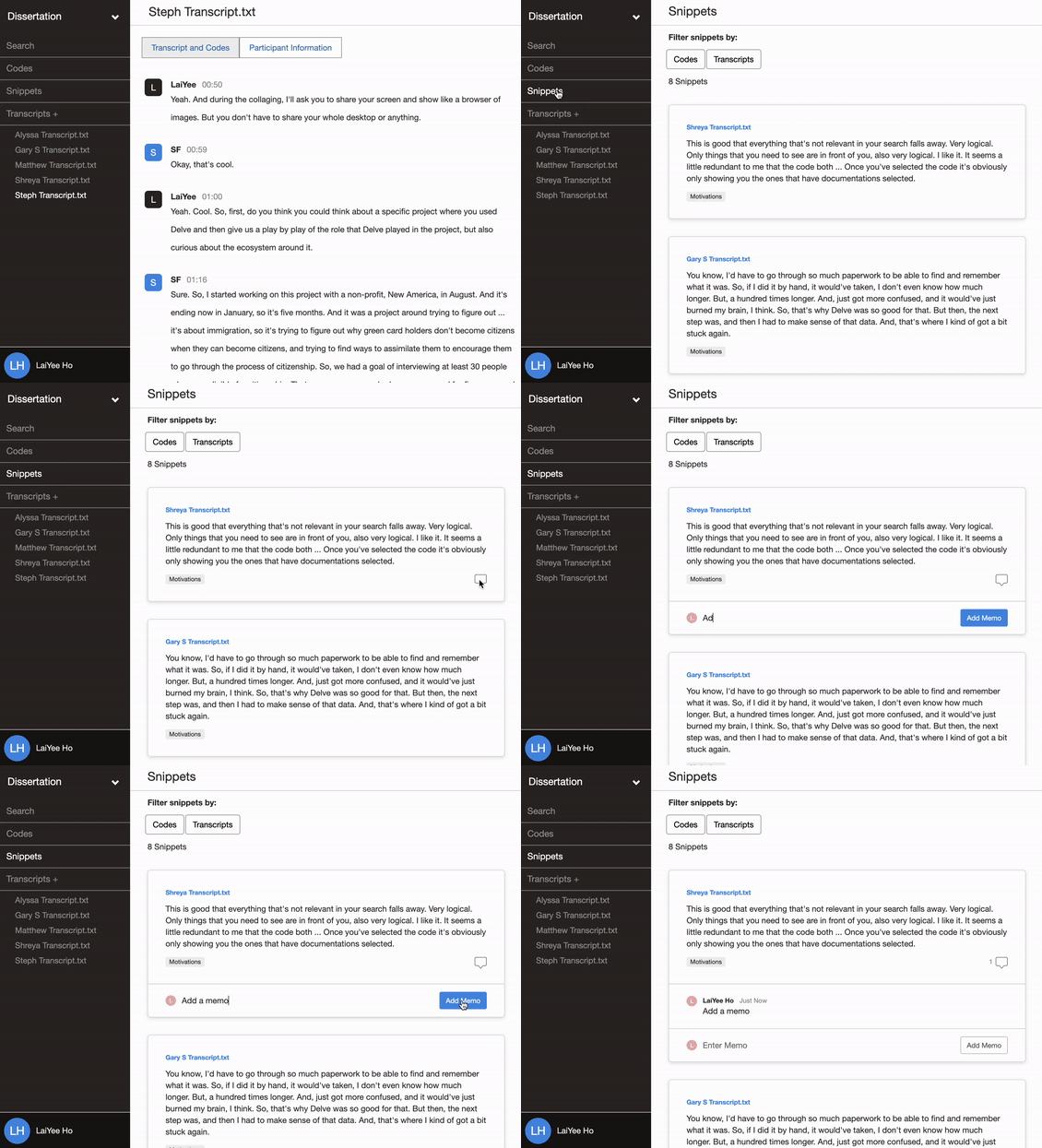
- Keep an audit trail. Document your coding decisions and the reasoning behind them as you work, not from memory afterward. Memos are the backbone of this record, and Delve lets you attach them to the snippet that prompted a decision or to the code as your definition develops.
- Track how your codebook evolves. Codes merge, split, and get redefined over a project. Recording those changes shows a reader your analysis developed deliberately rather than drifting.
- Check your coding for consistency. On your own, that can mean a code-recode check, returning to earlier transcripts to confirm you’d still code them the same way. On a team, it means intercoder reliability or consensus coding, so different people apply the same codes the same way.
- Consider a dependability audit. An outside colleague reviews your trail and confirms your process supports your conclusions, the qualitative equivalent of an external check.
On a team, dependability depends on everyone applying codes the same way. Intercoder reliability measures how well you do. Consensus coding and split coding are how you get there, by reconciling or dividing the work and comparing how each researcher reads the data.
These approaches double as researcher triangulation, where more than one analyst reading the data keeps your findings from depending on a single perspective. All of this reading, coding, and checking through iterative stages is much easier when your work lives in one shared project in Delve.
A published example: tracing dependability in a real study
Dependability is easier to picture in a study that shows its work. Isomöttönen and Zhidkikh (2025) interviewed 14 first-year computer science students about how they managed the jump into a university programming course, what helped them study, and how they used their teaching assistants for support.
Their dependability came from putting the analysis through more than one perspective rather than resting on a single reading. As the authors put it, dependability is addressed by bringing in multiple researchers so the results don’t depend on one person’s interpretation.
- Independent coding first. The two authors used split coding first and analyzed the transcripts separately, each coding seven of the fourteen interviews without seeing the other’s results.
- Reconciliation second. They then worked through every independent coding together across four half-day sessions with consensus coding. They compared interpretations, resolved overlaps, and revised the themes as a pair rather than letting one view stand unchecked.
The authors drew this multi-researcher process straight from Lincoln and Guba and named it as their answer to dependability. By exposing and discussing each coding decision, they kept the reasoning behind their themes consistent and open to inspection rather than the product of a single perspective.

[Note. The authors’ description of how they established dependability, from Isomöttönen and Zhidkikh (2025), published under CC BY 4.0. https://arxiv.org/abs/2506.13461]
How Delve helps with dependability
Dependability lives on whether your record stays organized, and that’s what a qualitative analysis tool is for. Delve keeps every piece of your audit trail connected, so any finding traces straight back to the data behind it.

Your audit trail stays in one place. Every code stays linked to its snippet, and every snippet to its transcript. You attach memos to the snippet that prompted a decision or to the code whose meaning you’re refining, and each code carries a description that holds it steady. When your codebook shifts, the record shifts with it, so nothing lives only in your memory.
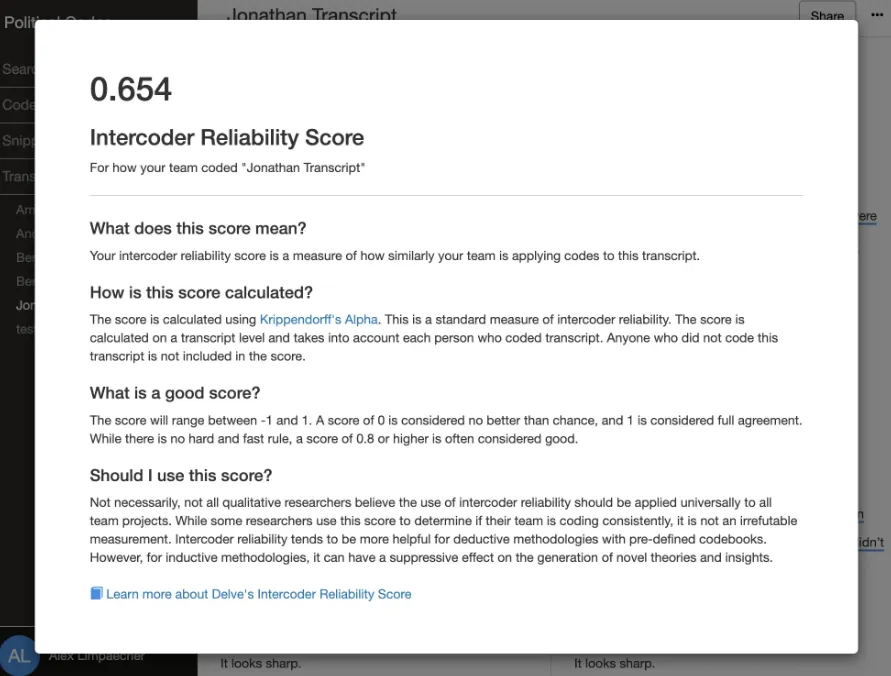
Team coding stays consistent. In a Delve project, researchers can code the same transcript without seeing each other’s work, so no one’s reading sways another’s, then run a coding comparison to see where they agree and diverge. This supports both consensus coding, where everyone codes the same transcripts, and split coding, where you divide them. When you need a formal number, the Delve qualitative analysis tool calculates intercoder reliability using Krippendorff’s alpha, so you can report agreement between researchers rather than just assert it.
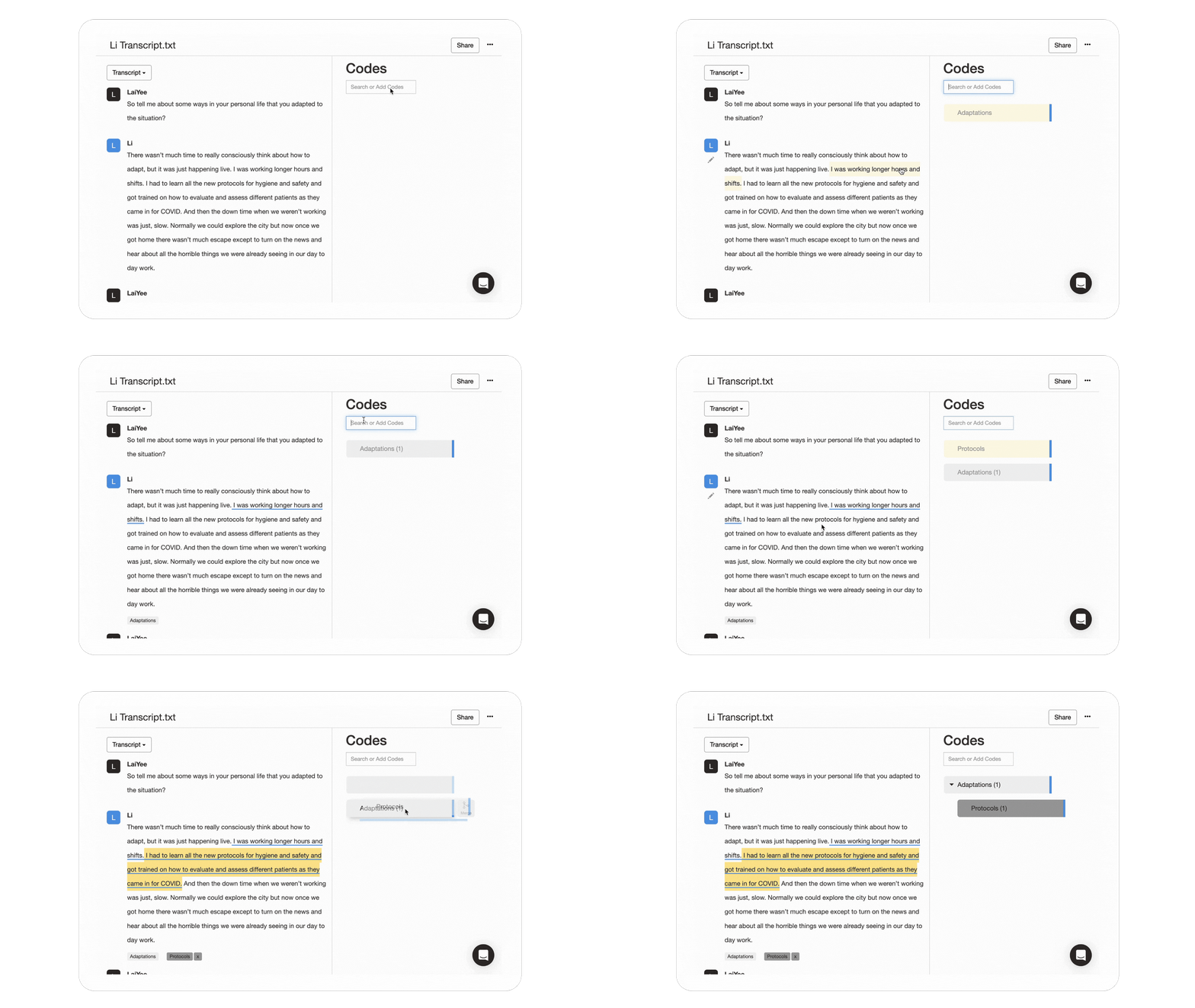
AI coding stays on the record. When you use Apply Codes Using AI to run your codebook across transcripts, Delve records why it applied each code in that snippet’s memo, the same field you’d use for your own notes. You have the final say on what to accept, and the evidence of every decision, yours or the assistant’s, stays attached to the data.
When someone asks how you reached a conclusion, the answer is already there in your project.
Establishing dependability with confidence
Dependability isn’t about defending a single right answer. It’s about showing your process was careful, consistent, and open enough that someone else could follow it and see how your findings took shape. Keep a clear record of your decisions as you make them, check your coding for consistency, and your analysis becomes something you can stand behind under scrutiny.
That record is far easier to maintain when it builds as you work rather than something you assemble at the end. Start a free trial of Delve and keep your audit trail organized from the first transcript.
Frequently asked questions
What is dependability in qualitative research? Dependability is the qualitative counterpart to reliability. It asks whether your research process was consistent and documented well enough that another researcher could follow your decisions from raw data to findings. You establish it through a clear, traceable record rather than by reproducing an identical result.
What does dependability mean compared to reliability? Reliability, a quantitative standard, asks whether the same measure produces the same result under the same conditions. Dependability asks whether your qualitative process was stable and transparent. It focuses on documenting how you coded and why, not on getting the exact same output twice.
How do you ensure dependability in qualitative research? You ensure dependability by keeping an audit trail of your coding decisions, tracking how your codebook evolves, and checking your coding for consistency through code-recode checks, intercoder reliability, or consensus coding. A shared workspace like Delve makes that documentation easier to maintain and show, since every code stays linked to its data and intercoder reliability calculates automatically as a team codes.
What is the difference between dependability and confirmability? Dependability is about the consistency and traceability of your process. Confirmability is about keeping your findings grounded in the data rather than your own bias. The two overlap because a single audit trail supports both, but they answer different questions.
What is the difference between dependability and transferability? Dependability records how you worked, so a reader can trace and trust your process. Transferability describes what you studied in enough depth that a reader can judge whether your findings apply to their own setting. Dependability points inward at your process, while transferability points outward toward other contexts.
What is an audit trail in qualitative research? An audit trail is the documented record of how you moved from raw data to findings: your coding decisions, the reasoning behind them, and how your codebook changed over time. It’s the main way researchers demonstrate dependability. Coding in a tool like Delve keeps that trail intact by attaching memos to the snippets and codes they explain, so the record builds as you work.
Related resources
- Trustworthiness in qualitative research, the parent framework and its four criteria
- Transferability in qualitative research, the sibling criterion on applying findings elsewhere
- Reflexivity in qualitative research, on examining your own influence on the analysis
References
- Lincoln, Y. S., & Guba, E. G. (1985). Naturalistic inquiry. Thousand Oaks, CA: SAGE. https://searchworks.stanford.edu/view/6721278
- Isomöttönen, V., & Zhidkikh, D. (2025). Navigating through CS1: The role of self-regulation and supervision in student progress. arXiv. https://arxiv.org/abs/2506.13461
Cite this article
Delve, Ho, L., & Limpaecher, A. (2026, August 4). Dependability in qualitative research: What it means and how to establish it. https://delvetool.com/blog/what-is-dependability-in-qualitative-research