
This is part of our Ultimate Guide to Qualitative Software | Start a Free Trial of Delve | Take Our Free Online Qualitative Data Analysis Course
Coding a set of transcripts for qualitative research tends to produce more decisions than you’d expect. You might merge two codes, rename another, or drop a theme once the data behind it thins out. Then a reviewer asks why, and the reasoning sounds right in your head. You just can’t point to where it lives in your data.

Confirmability is how you show your findings came from your data rather than from what you expected to find. It doesn’t ask you to have no views or insight. It asks you to leave a record of where your views entered the analysis, so someone else can follow your reasoning and reach the same place.
That record-building works best if it happens while you work, because it’s difficult to reconstruct after the fact. Below are the six things a confirmability record holds, why it usually falls apart, and how a qualitative analysis tool like Delve keeps your reasoning next to the passage that prompted it.
What confirmability in qualitative research means
When a reviewer asks about the confirmability of your qualitative research, they want to know whether another researcher could trace your findings back to your data. Lincoln and Guba (1985) proposed it as one of four trustworthiness criteria, standing in for what quantitative research calls objectivity.
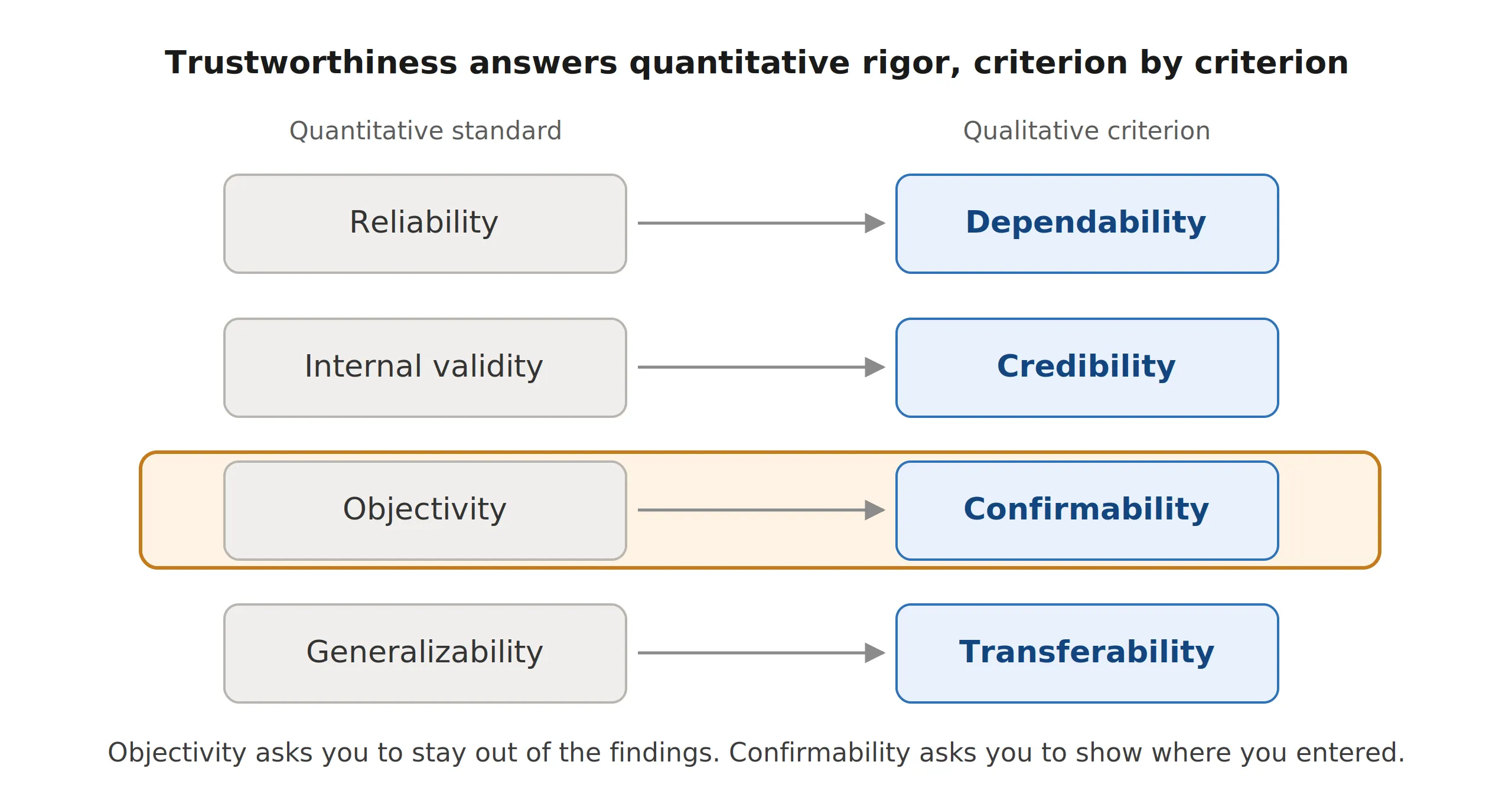
Objectivity in quantitative research basically asks the researcher to remove themselves from the findings. Qualitative research can’t offer that, because you are the instrument who assigns meaning. You chose the questions, noticed some things and not others, and made an interpretation of what a passage meant. Confirmability accepts all of that and asks you to make your influence traceable enough that someone else can audit it.
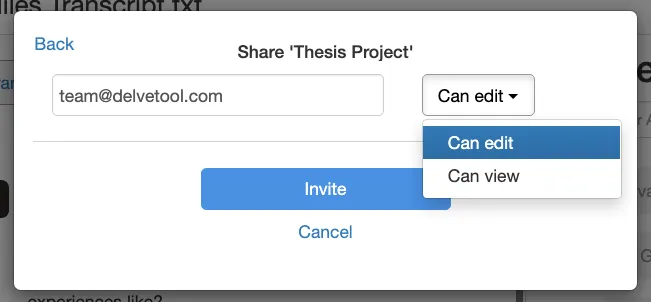
What Lincoln and Guba termed an “auditor” is another term for a peer debriefer outside the research team who reads your records and decides whether your findings hold up. That process is challenging, because your codes, your reasoning, and your transcripts may live in different places. Your transcripts might be Word files in a folder, your reflexive notes in a paper notebook, and the reason you renamed a code in an email to your supervisor. A shared project in Delve qualitative data analysis tool, gives them one thing to open, and they can read it all in one place.
The other criterion for trustworthiness asks different questions. Dependability asks whether your process can be traced, which puts it closest to confirmability, though dependability asks what you did and confirmability asks why. Credibility tests your reading against people outside the analysis, and transferability gives your reader enough context to judge whether your findings apply elsewhere.
What goes into a confirmability audit trail
Confirmability depends on an audit trail with six categories, which Lincoln and Guba adopted from Halpern (1983). You will find you make nearly all of these records while you work through your study, but they tend to end up scattered across separate locations:
- Raw data. Your transcripts, field notes, and documents, in the form they arrived.
- Data reduction products. Your codes, your code definitions, and the passages under each one.
- Data reconstruction products. Themes, their sub-codes, and any structure you imposed on top.
- Process notes. Why you merged those two codes. Why you renamed one. What you rejected.
- Materials on intentions. Your proposal, your research questions, and how they shifted.
- Instrument development. Your interview guide and every revision to it.
Three of those categories build themselves while you code. Your transcripts are the raw data, your codes and their definitions are the data reduction products, and your themes are the data reconstruction, and a tool like Delve holds all three in one project.
.gif)
Process notes are the exception, and they’re the category of confirmability. A decision is gone the moment you move to the next transcript, so it survives only if you write it where you made it. Merge two codes in Delve and you can leave a memo on the snippet that pushed you to do it. The reasoning stays on the passage instead of in your head, and your auditor finds it in the same place they find the code.
.gif)
Code definitions work similar to memos. Writing your code definition at the end describes where a code ended up, not what you meant when you first applied it to a specific snippet. Delve lets you write the definition with the code, then memo the code when it shifts, so an auditor can see both.
Examples of confirmability in qualitative research
Kaur and colleagues (2025) studied how Indian migrants in Australia understand their risk of heart disease, across 20 interviews conducted in English, Punjabi, Hindi, and Urdu. The lead author is an Indian immigrant, a cardiac nurse, and a native speaker of those languages. She ran and transcribed every interview herself. That closeness caught cultural meaning another analyst would have missed, and it put her assumptions closer to the data than anyone else’s.
She coded in two passes. The first pass was deductive. She turned each interview question into a main category and filed the data underneath it, so the top level of her codebook was established before she read a transcript. The second pass was inductive. She read line by line and let subcategories come out of what participants actually said.
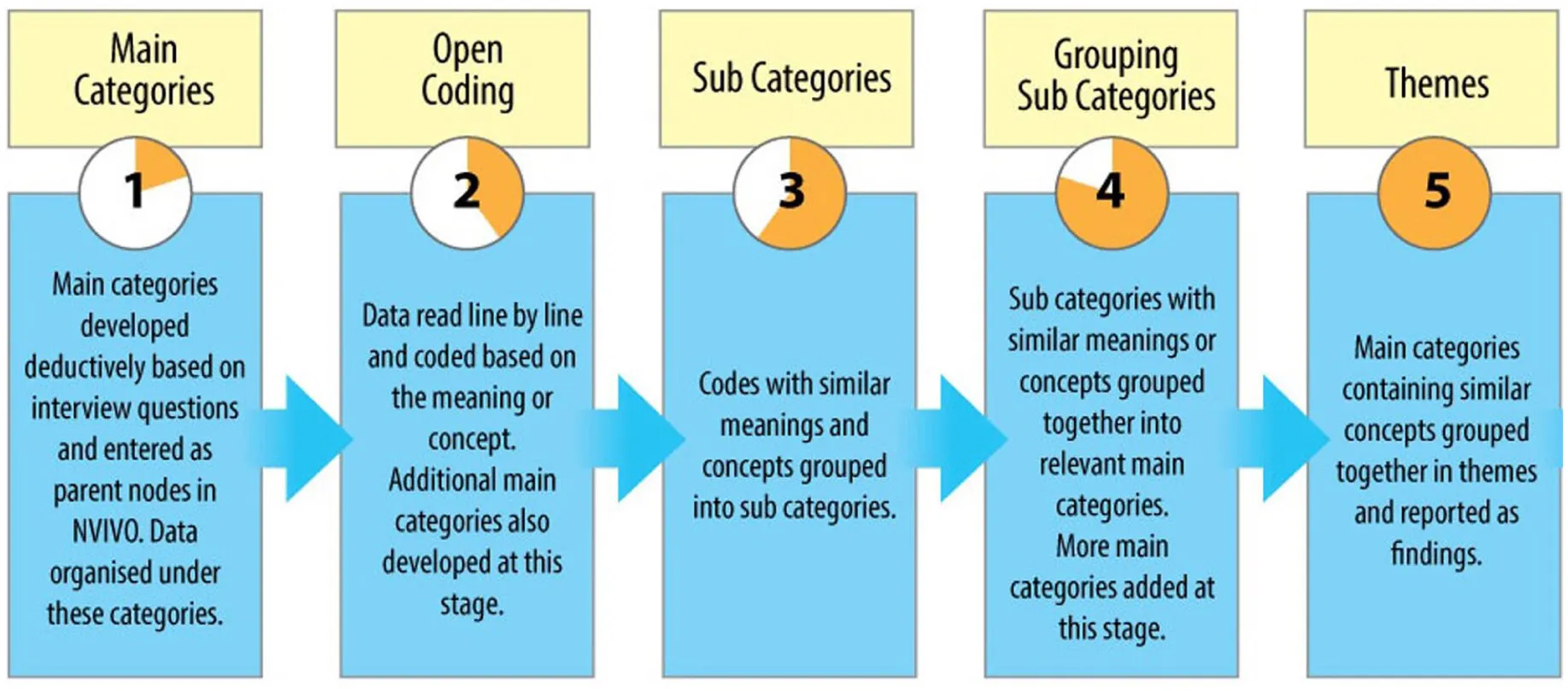
The five-step coding process, moving from deductive main categories to inductive subcategories and themes. Figure from Kaur et al. (2025), CC BY-NC 4.0.
Splitting the work that way does two things for confirmability. Every code has an origin you can point to, either a question from the interview guide or a set of passages. And her assumptions could only reach the second pass, since the main categories were fixed before she read a transcript. The second pass is where the team’s core insights turned up.
Before coding each interview, she wrote a journal entry about what she was thinking. In one entry she noticed she kept returning to the Punjabi interviews, and that most of the quotes she was pulling as examples came from them. She linked it to her own ties to the language and the region, and wrote that she needed to go back through the interviews from other states. Writing before coding rather than after is what made that visible, because the assumption was on the page while it was still shaping her reading.
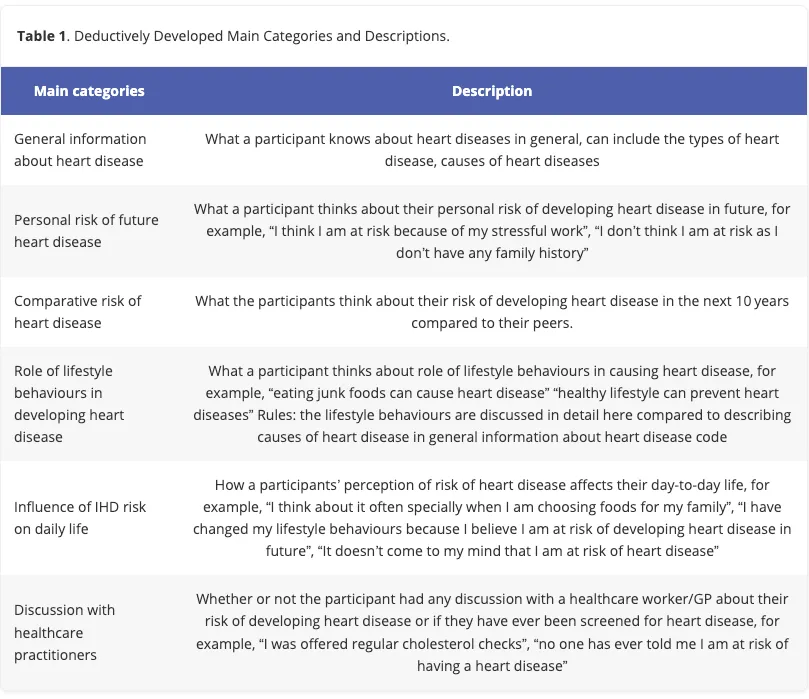
Every main category in their codebook carried a written description of what belonged in it. Table from Kaur et al. (2025), CC BY-NC 4.0.
The team’s codebook did the rest of the work. Each main category came with a written description of what belonged in it, so a reader can see what a code was meant to capture rather than guess at it. An auditor reading that codebook would need the definition you were working from, and the passages you filed under it. Building your codebook in Delve keeps all the pieces tied together.
Delve holds that structure together with nested codes. One way to set that up, if you coded in two passes like Kaur did, is to make your deductive categories parent codes and nest the inductive ones underneath. Nesting groups related codes whatever their origin, so this works the same way for a codebook that’s entirely one or the other. Open any code and an auditor gets the description you wrote at the time plus every snippet you filed under it.
Challenge: Your reasoning is scattered, unorganized, or untracked.
Kaur’s open coding ran in two coding cycles. New codes kept coming up as she worked through the interviews, so she went back to transcripts she had already coded and re-coded segments. Her codebook changed after her supervisors read a trial version and found some category descriptions hard to follow.
That’s how iterative coding is supposed to work, and every pass adds more decisions worth recording. Almost none of them get written down next to the passage that prompted them.
You might merge two codes because they were splitting the same idea. You rename a third because the label was leading you. You go back to transcript three and recode a passage under a category that didn’t exist a month ago. Each one is a reasoning step your auditor might ask about.
Working in a qualitative tool like Delve houses all that reasoning in the same web-based location:
- Merging two codes. Write the reason as a memo, instead of leaving it in your head.
- Renaming a code. Note what the old label was getting wrong, instead of in an email thread.
- A reflexive note. Put it on the snippet that triggered it, instead of a separate file.
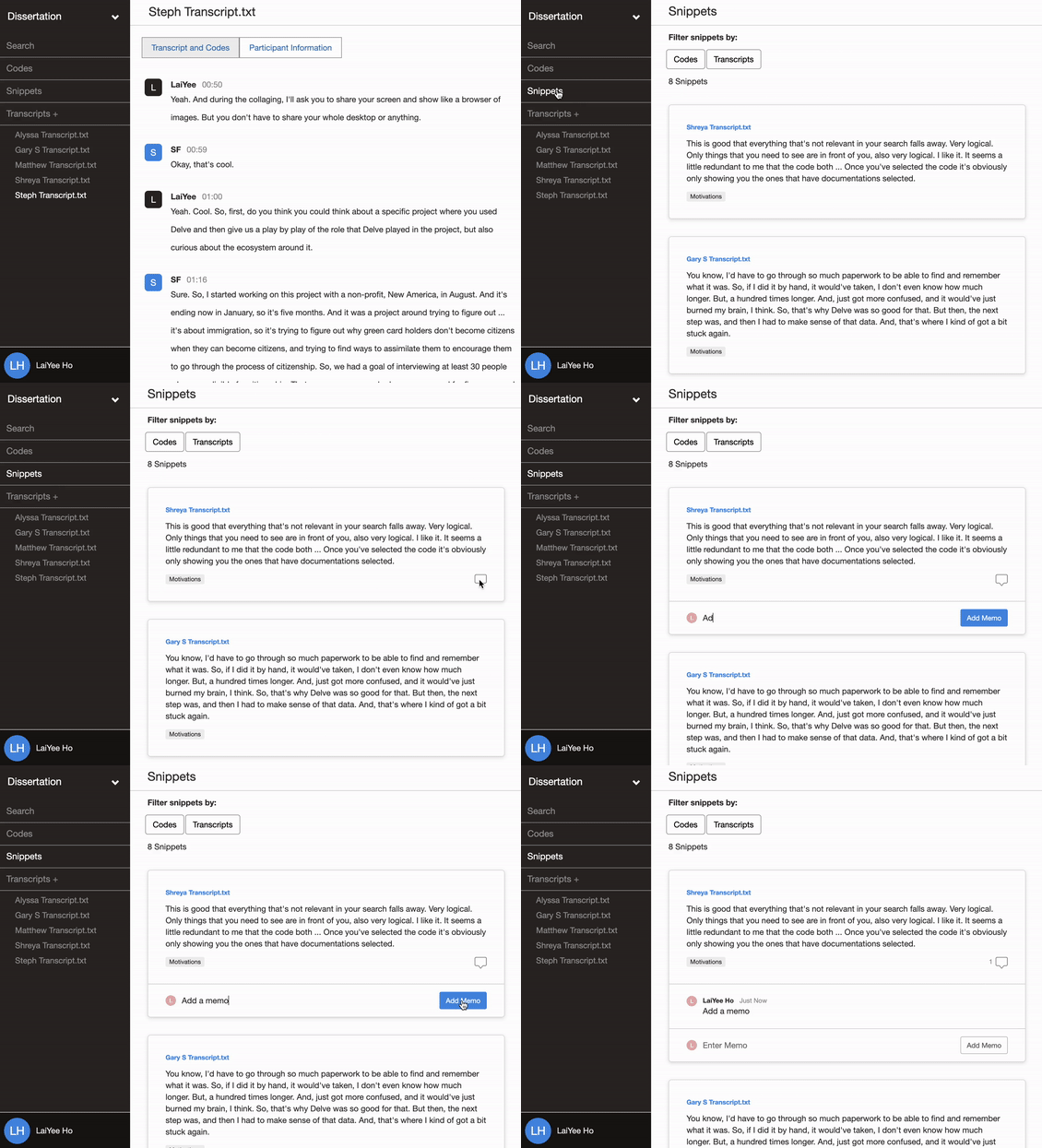
By the time you get to your methods section, the material is already there. Every decision and the reason behind it is in the project waiting for you, so writing it up is transcription rather than recall.
Turn your audit trail into a crystal-clear confirmability section
Every time you apply, merge, or edit a code in Delve, you can write down why. A memo on the snippet that prompted it, a note on the code itself, or a revised definition. By the end of coding, the audit trail is already there to pick up and piece together.
That changes what you can write. Most confirmability paragraphs say “we kept a reflexive journal and did an audit trail.” Lincoln and Guba’s six categories describe what that record holds, but not where to keep it, and that’s the part that decides whether anyone can follow your bread crumbs.
A stronger methods section names the decision, points to what in the data prompted it, and says where the record sits in your project.
Table: What an auditor asks for, Delve delivers
| Audit trail category | Where the record slips | How Delve helps |
|---|---|---|
| Process notes | The reason behind a merge or a rename is never written anywhere | Write a memo on the snippet that prompted the decision, dated as you go |
| Data reduction products | Code meanings drift, and the definition you used in month two is gone | Code descriptions hold each code’s meaning where anyone opening it can read it |
| Reflexive notes | Your positionality file sits apart from the passages it should be attached to | Memos attach to codes and snippets, so a note about your own reading sits on the passage that triggered it |
| Materials for an auditor | The trail exists across four applications and nobody can follow it | Export your codes, memos, and transcripts to Word or CSV as one package |
Every row of the table is a sentence or contribution you can put in your methods, including which decisions you documented and when and what your reflexive notes flagged. Hear from students and university research teams already working this way in Delve, and where they are saving the most time.
Start a free trial of Delve and let your audit trail build itself while you code.
Frequently asked questions
What is confirmability in qualitative research? Confirmability asks whether your findings came from your data rather than your own assumptions. It’s one of Lincoln and Guba’s four trustworthiness criteria and the qualitative counterpart to objectivity. You establish it by documenting your analytic decisions as you make them, so another researcher can trace your findings back to the passages behind them.
How do you establish confirmability in qualitative research? You build an audit trail covering six categories: raw data, data reduction products, data reconstruction products, process notes, materials on your intentions, and instrument development. Reflexive notes and analytic memos carry most of the weight, since they record reasoning that would otherwise go unwritten. Peer debriefing and triangulation support it by putting a second reading against your own.
What is the difference between confirmability and dependability? Dependability asks whether your process was consistent and traceable. Confirmability asks whether your findings came from the data rather than from you. They rely on the same audit trail, which is why they’re often reported together, but a process can be perfectly traceable and still be driven by researcher assumptions.
What is the difference between confirmability and credibility? Credibility asks whether your reading matches your participants’ reality, and you test it against people outside the analysis. Confirmability asks whether your findings came from the data, and you demonstrate it through your own documentation. One looks outward, the other inward.
Is confirmability the same as objectivity? No. Objectivity assumes a researcher can be removed from the findings. Confirmability accepts that you shape the analysis and asks you to make that influence visible and auditable instead.
What do you write in a confirmability statement? Name the records you kept, when you kept them, and what they show. A decision you documented, what prompted it, and where an auditor would find it does more than a general claim that a reflexive journal was maintained.
Related resources
- Trustworthiness in qualitative research, the parent framework and its four criteria
- Credibility in qualitative research, on testing your reading against people outside the analysis
- Dependability in qualitative research, the sibling criterion on tracing your process
- Transferability in qualitative research, on whether findings apply elsewhere
- Reliability and validity in qualitative research, on how the quantitative terms translate
- Reflexivity and memos
References
Braun, V., & Clarke, V. (2022). Thematic analysis: A practical guide. London: SAGE.
Halpern, E. S. (1983). Auditing naturalistic inquiries: The development and application of a model [Unpublished doctoral dissertation]. Indiana University.
Lincoln, Y. S., & Guba, E. G. (1985). Naturalistic inquiry. Thousand Oaks, CA: SAGE. https://searchworks.stanford.edu/view/6721278
Kaur, K., Abu-Qamar, M. Z., Rashidi, A., McKay, N., & Saunders, R. (2025). Applying hybrid coding and reflexivity in qualitative content analysis: An exemplar. Global Qualitative Nursing Research, 12. https://doi.org/10.1177/23333936251395024
Cite this article
Delve, Ho, L., & Limpaecher, A. (2026, September, 08). Confirmability in qualitative research: What it means and how to establish it. https://delvetool.com/blog/confirmability-in-qualitative-research