This is part of our Ultimate Guide to Qualitative Software | Start a Free Trial of Delve | Take Our Free Online Qualitative Data Analysis Course
Sometimes quantitative survey results raise more questions than they answer. Maybe older respondents rate you far lower than everyone else, or a number defies what you expected by a wide margin. The initial survey responses alone just can’t explain what you’re missing.

Explanatory sequential design offers a path to fill that knowledge gap. You take the finding that needs more explanation and interview survey participants to learn what the numbers alone could not.
The whole design hangs on tying each interview answer back to the survey result it explains. A tool like Delve keeps that link in place, holding every code to its original snippets in one project that everyone on your team works from.
How explanatory sequential design works, from general to specific
Explanatory sequential design moves from the population to the person. It’s a mixed methods design combining qualitative and quantitative analysis built on deductive analysis. You start from a broad result and work down to the specific cases. This design fits research where you trust the numbers but not their meaning, and want the explanation to come from the people the data describes.
With an explanatory sequential mixed method design, you start broad, then zoom in over three stages:
- Start with the numbers (QUAN). You collect data from a large sample and analyze the results. You get statistics, patterns, and the occasional surprising result that needs an explanation.
- Choose what to probe. You use the quantitative survey results to decide which findings and which participants to follow up on.
- Explain it (QUAL). You interview a focused subset of people to understand the reasons behind the numbers. You get context, motivation, and the human story behind the initial survey results.
.cMjxNdDu_ZqOh6R.webp?dpl=dpl_9xWstzPuJaMBEtUp5sNWrkoonfGN)
If you don’t yet have a survey and the topic itself is under-explored, exploratory sequential design comes at things from the other end. You start with interviews to learn what matters to people, then build a survey to measure what they tell you. Both mixed methods designs pair survey data with qualitative interviews, but you flip the order of operations.
When to use explanatory sequential design
The term itself comes from Creswell and Plano Clark (2007), who mapped out the main mixed methods designs and gave this one its name. The pair suggest the explanatory design route when:
- You already have the data. A survey, an experiment, or a dataset already gives you numbers to work from.
- The results surprise you. Outliers, subgroup differences, or aberrant trends you didn’t expect call for further explanation.
- You need the “why” for other people. Stakeholders or readers want the reasoning behind the numbers beyond just the numbers.
So if you don’t yet know what to measure or no survey exists, use exploratory sequential design instead. The interview process comes first and those results tell you what the survey should ask.
Handling the handoff, from survey results to interview questions
The survey tells you where to look, but not why it stands out. As Creswell and Plano Clark explain, the quantitative results are what shape the qualitative follow-up, so a statistical anomaly gives you a reason to interview a particular group. When a specific subgroup drives a result, those are the people to talk to first. And each interview needs to tie back to the finding that singled them out.
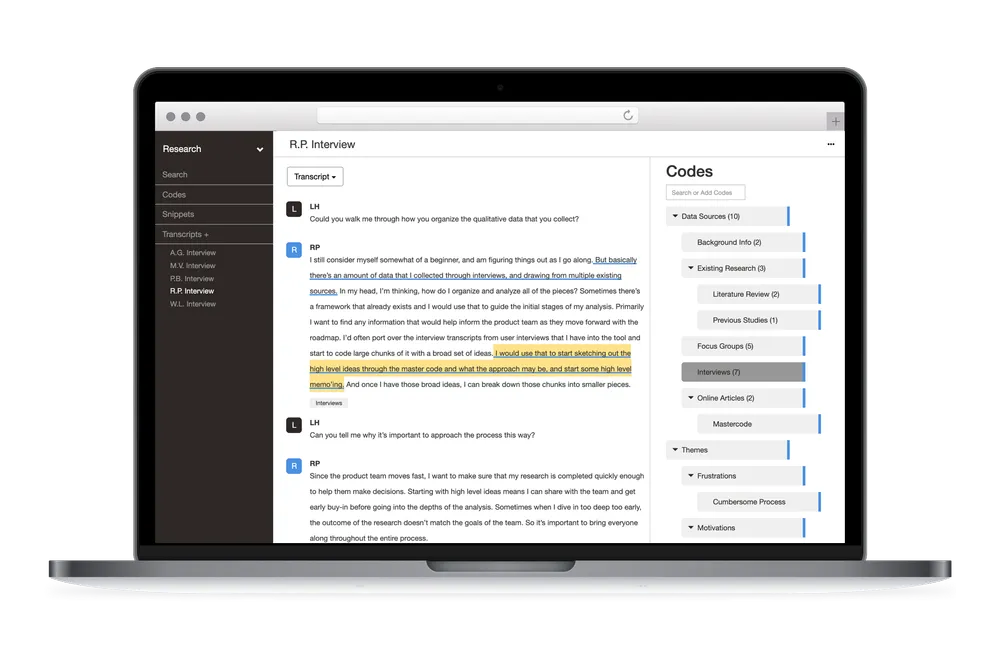
Holding that tie together is the hard part. Once you move into the interviews, your reasoning lives across a stack of transcripts. When you’re jumping between the survey and a dozen of transcripts, it is easy to lose track of which code explains which finding, and all the times it appears. Delve is a qualitative coding software that centralizes your project files. You just highlight a snippet of a transcript, attach a code, and that code stays tied to the finding it explains.
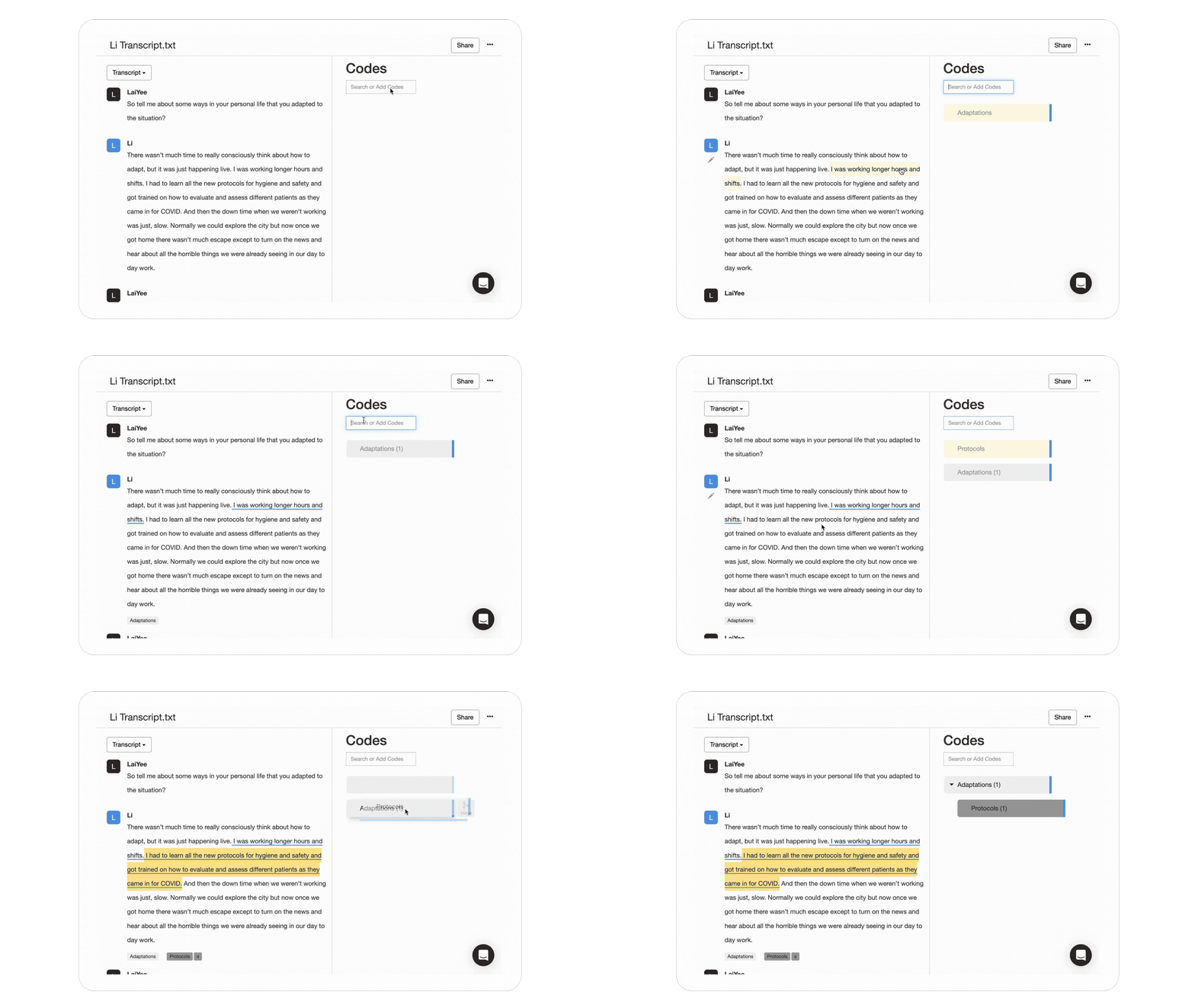
And you can add a memo that records your thought process. Nothing drifts loose, so when you write up the study, each finding traces back to specific examples.
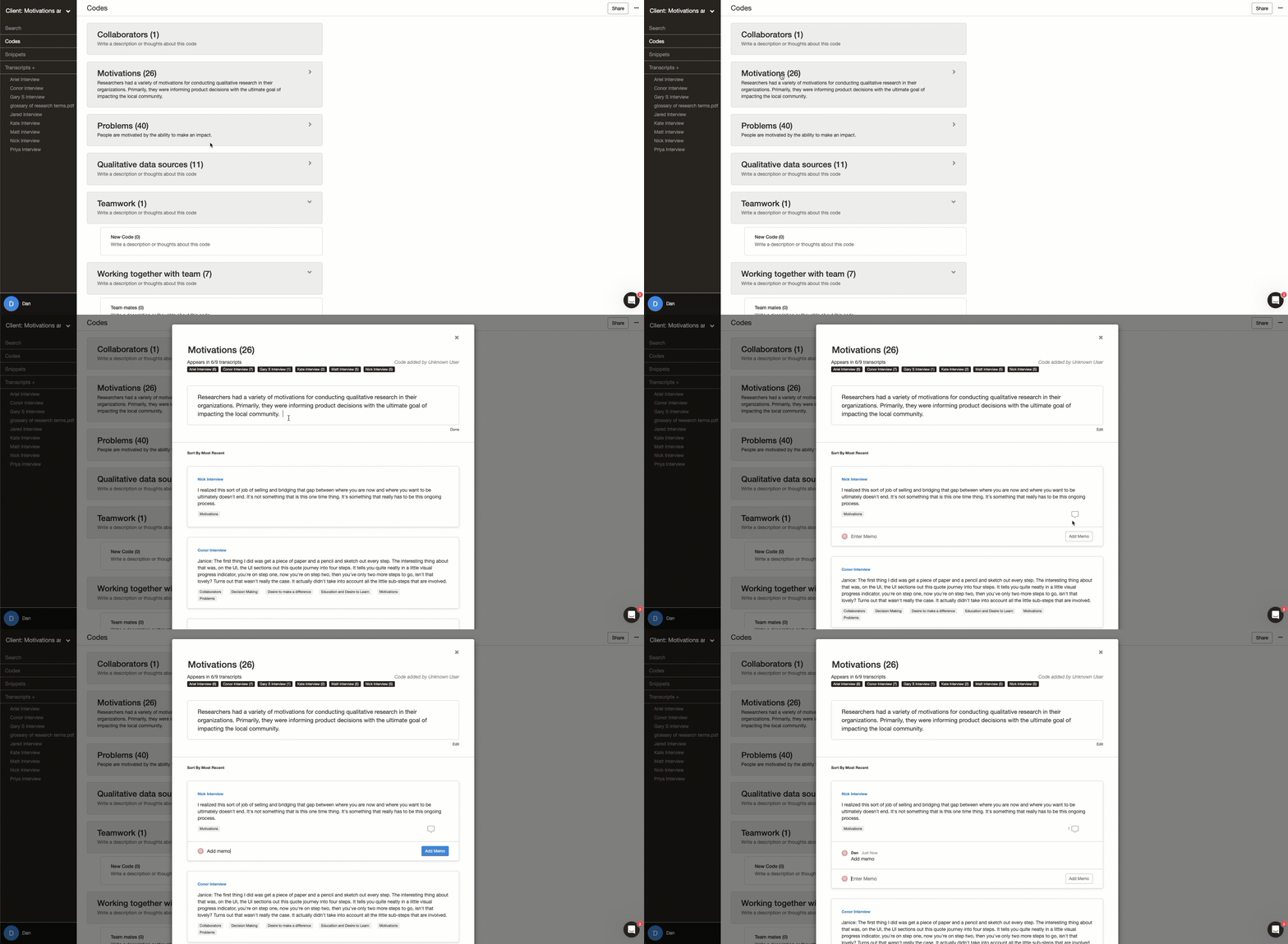
Once your interviews are coded, Delve gives you a few ways to look at what you found. You can filter your coded quotes down to one group of participants, or ask Delve’s AI to summarize what you coded under a theme. Everything’s in one place instead of scattered across transcripts or loose documents.
Real example of explanatory sequential design
Let’s look at how the handoff works in a real study from a team of health researchers in England. The group wanted to understand how patients felt about an at-home test kit their doctors had started using to check symptoms. Their research process followed the explanatory sequential design process.
- Phase one, the survey. The team mailed surveys to patients who had completed the kit and heard back from 260 of them. Satisfaction with the kit itself ran high at 88.7 percent, but it dropped for the doctor’s consultation (74.4 percent) and for how results were delivered (76.2 percent), and fell further among patients never told what the test was for. The numbers marked where the experience broke down without saying why.
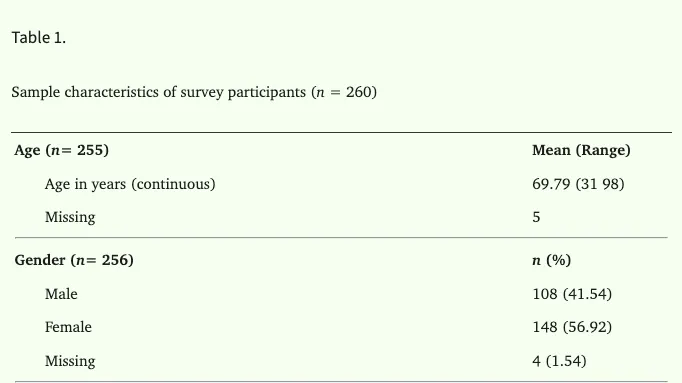
[Credit: Table 1 from Patient experience and acceptability of symptomatic FIT testing: An explanatory sequential multi-methods evaluation]
- The handoff. The survey results defined the follow-up. The team invited responders to interviews built around the weak spots the numbers had exposed, so each conversation started from a specific finding rather than a blank page.
- Phase two, the interviews. Twenty responders took part, and during each call the interviewers kept that person’s survey answers in front of them, following up on the ratings and written comments directly. Using thematic analysis, they coded the transcripts in sets of four and stopped once four straight interviews produced no new codes or insights.
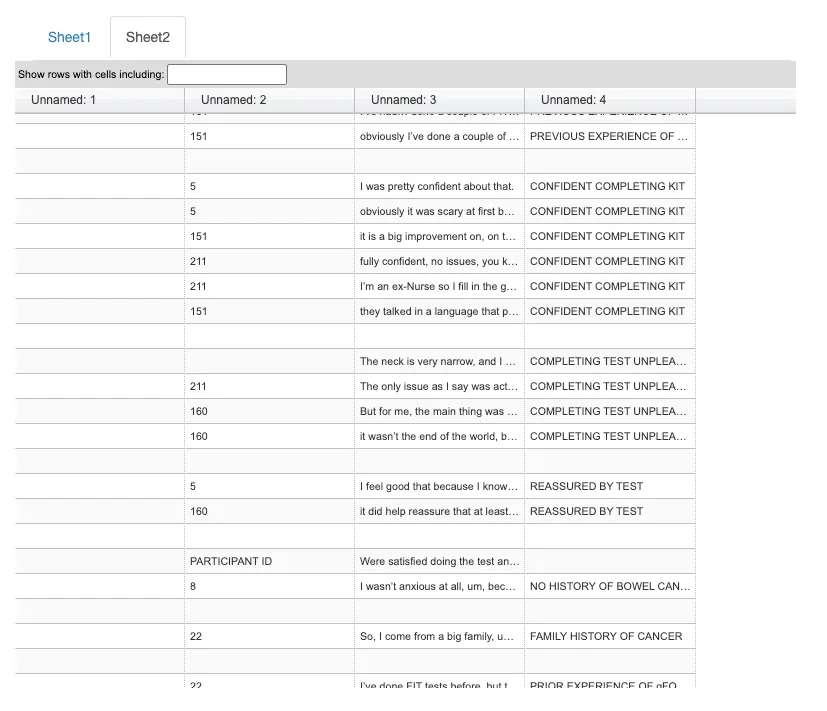
[Credit: Qualitative results Patient experience and acceptability of symptomatic FIT testing: An explanatory sequential multi-methods evaluation]
The survey found where patients were let down. Participants gave lower marks on the consultation and on how results were delivered, and the interviews explained why. That link between a number and its reason is what an explanatory design rests on, and coding the answers and interviews together keeps each explanation attached to the finding that prompted it.
The problems explanatory sequential design solves, and where Delve helps
Once you have survey results on one side and a pile of interviews on the other, keeping them straight is the hard part. Which interview explained that result? Which subgroup did this quote come from? Can a reviewer trace how you got from the numbers to your interview questions to your results? How trustworthy are the results? Delve holds the two phases together.
| The problem | How explanatory sequential design solves it | How Delve helps |
|---|---|---|
| Your survey shows a pattern nobody can explain | Follow-up interviews ask the people behind the numbers directly | Code the interviews and open-ended responses in one workspace |
| You don’t know who to interview | Phase one results point you to the subgroup driving the finding | Filter the survey in Delve to that subgroup and read answers together |
| Explanations drift away from the findings they explain | The design ties each interview to a specific phase-one result | Attach memos linking each coded explanation to the finding it accounts for |
| Reviewers ask how you connected the two phases | The sequence itself documents that the numbers shaped the questions | Delve links the coding trail from initial finding to explanation |
Turn your surprising survey results into answers you can defend
An explanatory study is only as strong as its follow-up interviews you do. Numbers without the why leave your readers guessing, and a longer survey just produces more patterns you can’t explain. When every explanation stays tied to the finding it addresses, the numbers and the reasons finally add up to one story.
Keeping that connection intact, from the first coded transcript back to the number that prompted it, is the problem Delve was built to solve. If you work with a team, everyone codes in the same project at once, so there are no files to email around or merge at the end. You can learn the platform in an afternoon rather than over days of training, which is one reason real users rank it among the easiest QDA tools to learn.
Your numbers show the scale, your qualitative interviews supply the reason, and together they tell the whole story from your participants. Start a free trial and turn outlier results into answers you can defend.
Frequently asked questions
- What is the difference between explanatory and exploratory sequential design? Explanatory runs quantitative first, then qualitative, moving from general to specific. Exploratory runs qualitative first, then quantitative, moving from specific to general. Same two strands, opposite order. Explanatory explains numbers you already have. Exploratory builds a measure from what people say.
- When should I use explanatory sequential design? Use it when you already have quantitative results, when a finding surprises you, or when you need to explain the reasons behind the numbers. The qualitative phase tells you why the patterns appeared.
- What software helps with the qualitative follow-up? The follow-up runs on coding, so a tool built for that keeps your interviews tied to the findings they explain. Delve lets you code interviews and open-ended responses, attach memos, and connect each explanation back to the data.
Related resources
- Mixed methods research, an overview of combining qualitative and quantitative work
- Qualitative survey analysis, on coding open-ended survey responses
Citations
Creswell, J. W., & Plano Clark, V. L. (2007). Designing and conducting mixed methods research. Thousand Oaks, CA: SAGE Publications. https://searchworks.stanford.edu/view/6721278
Cite this article
Delve, Ho, L., & Limpaecher, A. (2026, August 4). Explanatory sequential design: A practical guide. Delve. https://delvetool.com/blog/explanatory-sequential-research-design-delvetool