This is part of our Ultimate Guide to Qualitative Software | Start a Free Trial of Delve | Take Our Free Online Qualitative Data Analysis Course
Exploratory and explanatory sequential design are both sequential mixed methods designs, despite both names sounding very similar. They both pair a survey with interviews, and run in two phases. The difference between them is the order of those two phases.

Exploratory sequential design runs the qualitative interviews first and builds a survey from what participants tell you. Explanatory sequential design runs the quantitative survey first, then uses follow-up interviews to explain the numbers you already have, but can’t quite explain all of them. Exploratory is where you explore with interviews first. Explanatory is where you explain the numbers after.
.C26Pc4Hx_gMxk.webp?dpl=dpl_ERESCkC5BzAKyvG6TjTCMrMtYS2C)
Moving between interview transcripts and survey data is the hard part. You need to keep every survey question or explanation tied back to the participant, which is what tools like Delve do. Your codes, quotes, and survey responses stay connected instead of scattered across documents. This guide walks through exploratory and explanatory sequential design, when to reach for each one, and how to keep the two straight when you choose a design for your own mixed methods study.
The difference between explanatory sequential design and exploratory sequential design
Both research designs were named by Creswell and Plano Clark (2007). Both are mixed methods approaches that pair a qualitative and a quantitative phase. Running both halves means your interview codes and your survey responses live in the same project, which is why researchers reach for a tool like Delve that codes interview transcripts and open-ended survey answers side by side.
-
Exploratory sequential design runs from the person to the population. You interview a small group first, code what they say into themes, and build a survey from those themes to test on a larger sample. The reasoning is inductive: you start with individual accounts and reason up toward a broader claim that applies to more people. \
-
Explanatory sequential design runs from the population to the person. You survey a large sample first, find a result that needs explaining, then interview a subset to understand why the numbers came out that way. The reasoning is deductive, where you start with a broad result and reason down to the cases behind it.
.C-UmPluo_ZdddFY.webp?dpl=dpl_ERESCkC5BzAKyvG6TjTCMrMtYS2C)
When to choose exploratory sequential design
Choose an exploratory sequential design when you don’t yet know which variables matter most. Creswell and Plano Clark also call it the “instrument development design,” because its job is to build a measure that doesn’t exist. It fits when you’re creating a new scale or framework, or when you simply don’t know which factors belong on the survey and need to talk to people to find out.
Here are three published studies, all on everyday topics, that started with interviews and built outward:
-
Physical activity in elementary schools. Walker and colleagues interviewed 15 elementary staff in a Texas district, seven principals and assistant principals, four PE teachers, and four classroom teachers. Coding turned up practices nobody had planned to measure, including motorlabs, brain breaks, and flexible seating. Those codes became a single survey question asking staff how widely each approach was used, on a five-point scale. When 247 respondents from 22 schools answered, 45.4% reported medium or high use of brain breaks and only 4.5% reported the same for motorlabs. The survey could only ask about motorlabs because the interviews found them.
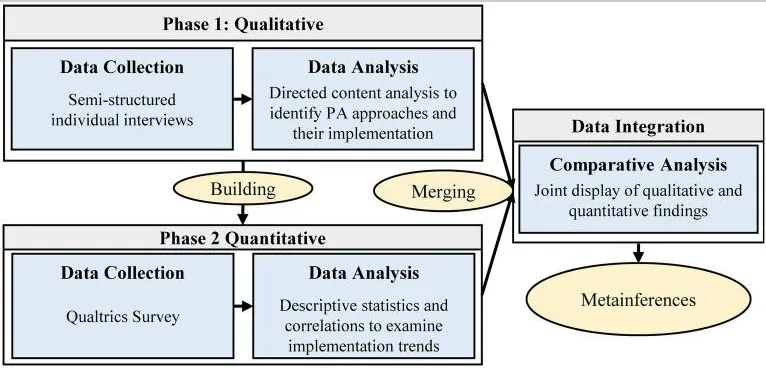
[Source: Walker et al. (2023), Frontiers in Public Health, CC BY 4.0.]
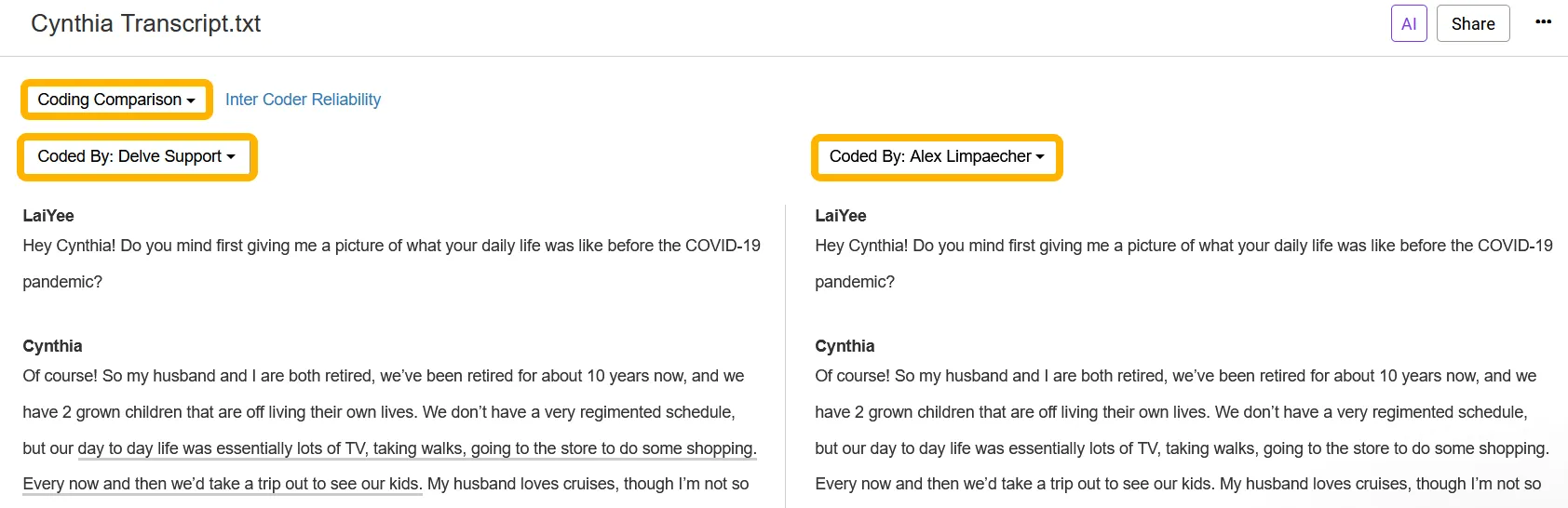
Three researchers coded the transcripts in Dedoose, a more complex coding alternative to DelveTool. They started with three transcripts each, coded independently, then met to reconcile before splitting the rest. Delve offers the same workflow inside one project without as much training required. The coding comparison feature shows you line by line where two people coded the same passage differently.
-
A nursing simulation safety tool. El Hussein, Harvey and Favell built the Simulation Safety Practice Tool from the patient safety literature, then asked 10 simulation experts to react to it. Thematic analysis of those 10 interviews drove the revisions, and each round of feedback changed the wording of the items. The quantitative phase, a survey, comes next. The experts ended up refining a tool the team had already drafted, which is a common way exploratory design plays out.
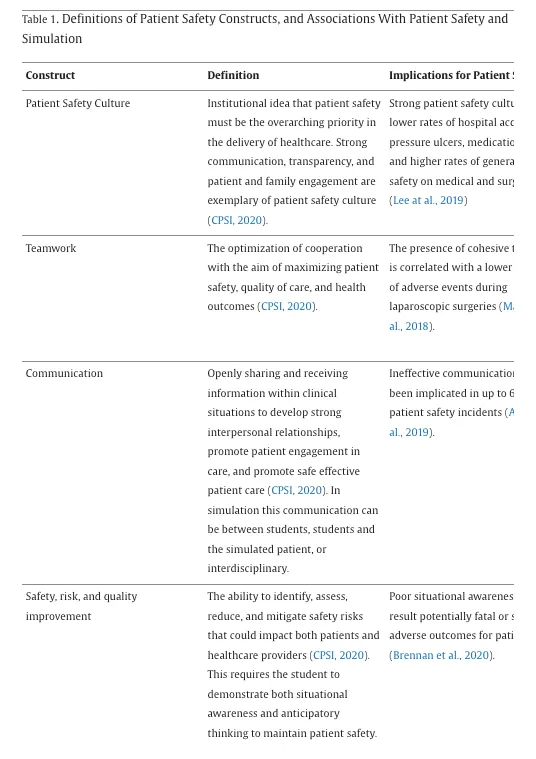
[Source: Hussein et al. (2025), Clinical Simulation in Nursing, CC BY-NC-ND 4.0.]
-
Employee rewards and recognition. Sreejith started with 11 unstructured interviews with software engineers, added 52 semi-structured ones, and ran a focus group with 15 project managers. Engineers ended up describing the same idea in different words, so the team grouped synonymous phrases together and ended with 31 unique criteria. Those 31 became the questionnaire, 443 employees rated it, and factor analysis pulled the ratings down to a smaller set of evaluation factors.
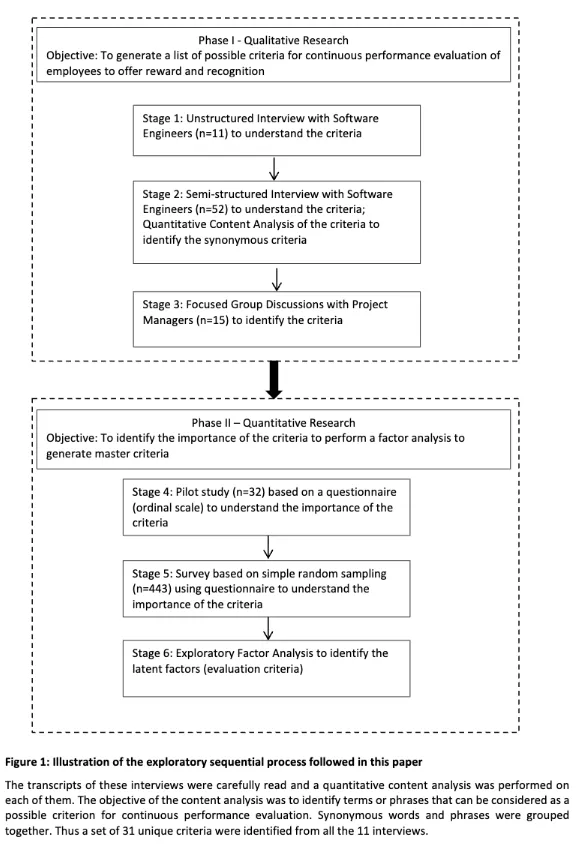
[Source: Sreejith (2023), Proceedings of the 22nd European Conference on Research Methodology in Business and Management.]
The qualitative coding portion of these projects gets particularly messy when you start folding several close codes together. In Delve qualitative tool, you can merge codes and keep every snippet attached to the surviving code, so the path from a survey item back to the chunk of text that produced it stays intact.
.gif)
Delve also makes it easy to nest and reorganize codes into themes as you go. Your survey sections come straight from the themes and every question traces back to the quote underneath it.
When to choose explanatory sequential design
Choose explanatory sequential design when you already have quantitative data and need to explain it. It fits when a survey turns up a result you didn’t expect, when one group answers unlike the rest, or when stakeholders want the reasoning behind the survey results rather than the results by themselves.
Here are three published studies where the numbers come first and the interviews explain them:
-
Students learning virtual care skills. Nowell and colleagues surveyed 107 students across education, nursing, medicine and allied health, and 93 finished. They ran a one-way analysis of variance (ANOVAs) on satisfaction and preparedness scores against faculty, age, gender, and experience with online learning technology. Fifteen students agreed to a follow-up and nine sat for one. Their accounts named the barriers behind the scores, including technological problems, limited access, and a sense of disconnection. Those nine students came out of the survey pool, chosen because of how they answered.
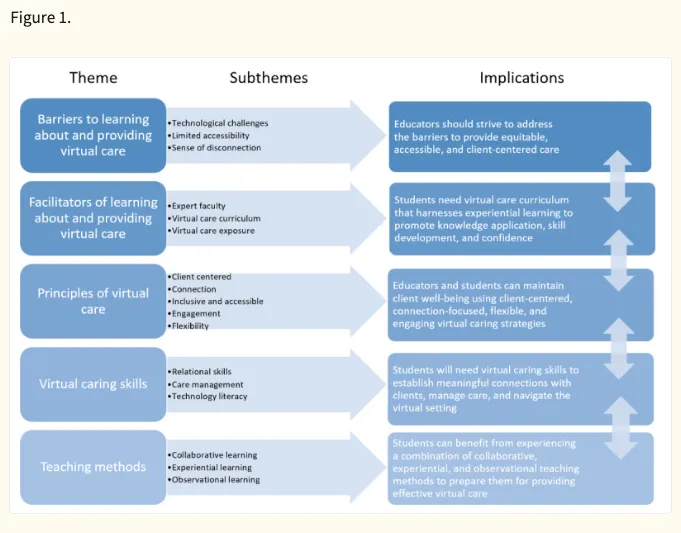
[Source: Nowell et al. (2024), JMIR Nursing, CC BY 4.0.]
-
A gamified telehealth training game. Three researchers measured 18 participants’ confidence and awareness before and after the role-play. Both rose significantly, and usefulness scored highest on the satisfaction questionnaire at 4.44 out of 5. The per-participant table shows something the average misses, since some participants recorded no change at all. The team interviewed 12 of the 18, analyzed the transcripts with framework analysis, and built a design framework out of what they heard.
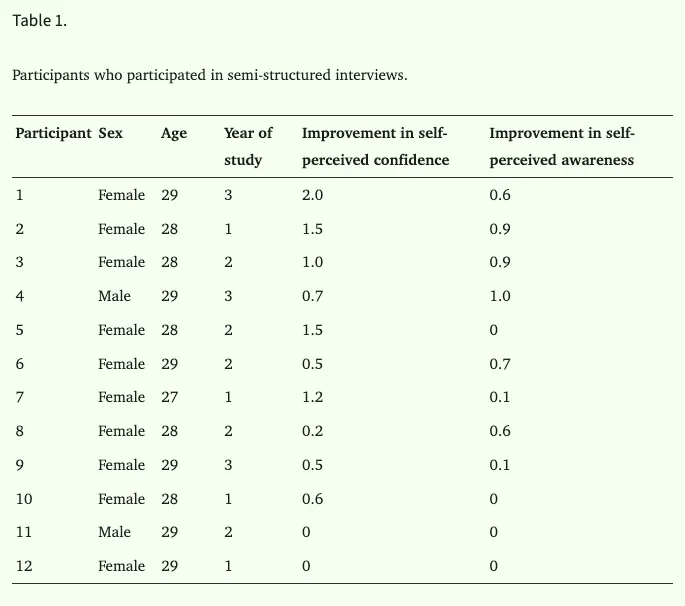
[Source: Teerawongpairoj et al. (2024), Scientific Reports, CC BY 4.0.]
-
Educators teaching online. A second Nowell study surveyed 82 educators in education, medicine, nursing and social work. Satisfaction with online teaching technology differed significantly by how long someone had taught online (P<.001) and by department (P=.001). Eight interviews then explained what was causing this split. Each interview explains one side of the difference in opinion, so keep track of which side.
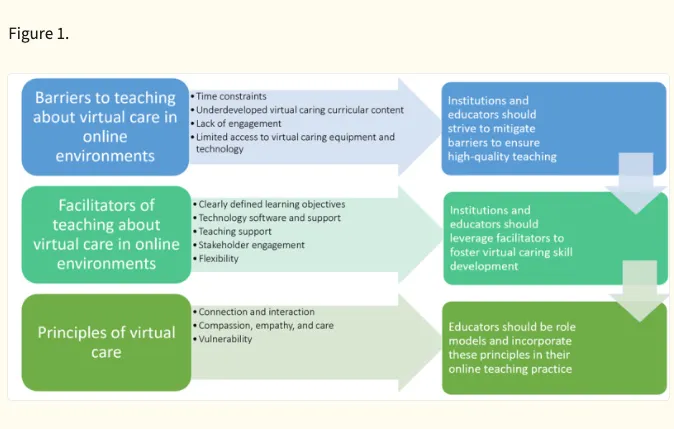
[Source: Nowell et al. (2025), JMIR Nursing, CC BY 4.0.]
The survey always points the way. Nowell’s team used the numbers to choose which students to interview, so the survey didn’t just raise the questions, it decided who could answer them. The tricky part once you are in the interviews, each explanation has to stay tied to the finding that prompted it, or by write-up you cannot say which quote answered which result.
Coding a follow-up interview that explains a survey result
"I rated the online sessions low because I never got feedback fast enough to fix anything."1 "When I could actually see the instructor's screen, it finally clicked."2
Codes:
1 Slow feedback loop – delays that made it hard to improve during the course
2 Value of live demonstration – seeing the instructor's screen made the concept click
This is where the two phases meet in one place. In Delve, you upload your survey responses and code the follow-up interviews in the same project, so when a result puzzles you, the coded comments that explain it sit right beside it. That connection is what keeps your findings traceable and trustworthy when a reviewer asks how you got there.
Table: Comparing exploratory and explanatory sequential design
| Exploratory sequential | Explanatory sequential | |
|---|---|---|
| Order | Qualitative, then quantitative | Quantitative, then qualitative |
| Direction | Specific to general | General to specific |
| Reasoning | Inductive | Deductive |
| Goal | Build a survey from what people say | Explain numbers you already have |
| Start when | You don’t know what to measure yet | You have results that need explaining |
| Phase-two output | A survey grounded in interviews | The reasons behind the findings |
Delve streamlines both sequential research designs
Whichever order you run them in, both designs put you in the same spot: coding interview transcripts and survey responses, and keeping every code tied to the words behind it. Across a dozen or more transcripts, that connection is the first thing to slip, and holding it together is what Delve does.
- In an exploratory study, you code your interviews and build survey questions from your themes, so every question traces back to a participant’s words.\
- In an explanatory study, you upload your open-ended survey responses and code them next to your follow-up interviews, so the comments explaining a result sit right beside it.
Delve handles the qualitative coding in both designs. You still run the survey itself and its closed-ended numbers in your own survey and statistics tools. If you work with a team, you all work on the same project files at once, so there are no files to merge or keep track of throughout the project.
.gif)
Compare Delve to NVivo, ATLAS.ti, and other qualitative coding software
Once you pick a research design, the qualitative coding part means interviews to code, themes to keep straight, and a team to keep in sync. If you’re weighing which tool to run it in, we compare Delve against NVivo, ATLAS.ti, MAXQDA, Dedoose, and Quirkos across the factors users care about most:
- Which is easiest to learn
- Which handles team collaboration best
- Which offers the most responsive customer support
- Which has the strongest AI features
- Which fits thematic analysis and grounded theory
- Which works best for teaching qualitative methods
You can also read how researchers use Delve over on our customers page.
Frequently asked questions
Are exploratory and explanatory sequential design the same thing? No. They share the same two phases but run them in opposite order. Exploratory sequential design goes qualitative first, then quantitative. Explanatory sequential design goes quantitative first, then qualitative. An easy way to remember it: you explore with interviews to build a measure, or you explain the numbers you already have.
When should I use exploratory vs. explanatory sequential design? Use exploratory sequential design when you don’t yet know enough about your topic to write good survey questions, so you interview people first and build the survey from what they say. Use explanatory sequential design when you already have survey results and need follow-up interviews to explain them. Both are mixed methods designs, and both rely on careful coding of the interview phase, which you can do in Delve.
What is the difference between sequential and concurrent mixed methods designs? In a sequential mixed methods design, one phase finishes before the next begins and shapes it, exploratory and explanatory designs are both examples. In a concurrent (or convergent) design, you collect qualitative and quantitative data at the same time and compare them afterward. Sequential designs fit when you want each phase to inform the next rather than run in parallel.
Is exploratory sequential design inductive or deductive? Exploratory sequential design is mostly inductive: you reason up from individual interviews toward a broader measure. Explanatory sequential design starts from a general result and works down to specific cases, though its follow-up interpretation still involves inductive reasoning. Either way, when you build codes and themes up from transcripts, Delve keeps each theme tied to the quotes it came from.
Can I analyze survey data in qualitative software for a sequential design? Partly. In both designs, Delve lets you upload your survey responses and code the open-ended answers alongside your interview transcripts, so all your qualitative work lives in one place. You still build and distribute the survey itself, and run the closed-ended numbers, in your survey and statistics tools. Delve handles the coding, not the statistics.
How do I keep a sequential mixed methods study organized across both phases? The hard part is keeping each survey question or explanation tied back to the participant who prompted it. Code your interviews in one project, nest related codes into themes, and attach memos that record why each decision was made. If you work with a team, everyone can code in the same project at once, and Delve calculates intercoder reliability so your coding stays consistent from the first transcript to the final write-up.
Which qualitative analysis tool is best for mixed methods research? The right tool depends on your workflow, but for the qualitative side of a sequential design you want one that keeps interviews and open-ended survey responses in the same place and is quick to learn. Delve is built for that, and we compare it against NVivo, ATLAS.ti, MAXQDA, Dedoose, and Quirkos on ease of learning, team collaboration, and AI features so you can decide for yourself.
Related resources
- Exploratory sequential design, a full walkthrough with a published example
- Explanatory sequential design, a full walkthrough with a published example
- Mixed methods research, an overview of combining qualitative and quantitative work
Delve vs. other tools
- ATLAS.ti vs. NVivo vs. Delve
- ATLAS.ti vs. MAXQDA vs. Delve
- ATLAS.ti vs. Dedoose vs. Delve
- MAXQDA vs. NVivo vs. Delve
- Dedoose vs. NVivo vs. Delve
- Quirkos vs. NVivo vs. Delve
- Top NVivo alternatives for dissertation students
- MAXQDA alternatives
- Dedoose alternatives
Related resources: Best QDA software by use case
- Easiest QDA software to learn
- Best QDA software for collaborative research
- Best QDA software for customer support
- Best software for thematic analysis
- Best software to teach qualitative analysis
- The ultimate guide to comparing qualitative coding software
Cite this article
Delve, Ho, L., & Limpaecher, A. (2026, September 15). Exploratory vs. explanatory sequential design: how to choose. Delve. https://delvetool.com/blog/exploratory-vs-explanatory-sequential-design